Date posted: 21-07-2026 | Last updated : 25-07-2026
“How much does temple filler cost?” is a common concern among people looking for a facial rejuvenation treatment that can improve balance and facial contours.
Fuller, more proportionate temples may help the face appear softer, fresher, and more harmonious. In some Asian cultures, well-defined temples are also associated with positive facial-reading or feng shui beliefs. The treatment cost varies depending on the patient’s needs and the selected filler service.
Temple filler injections generally cost approximately equivalent to around USD 190–456 per cc.
The final cost depends on:
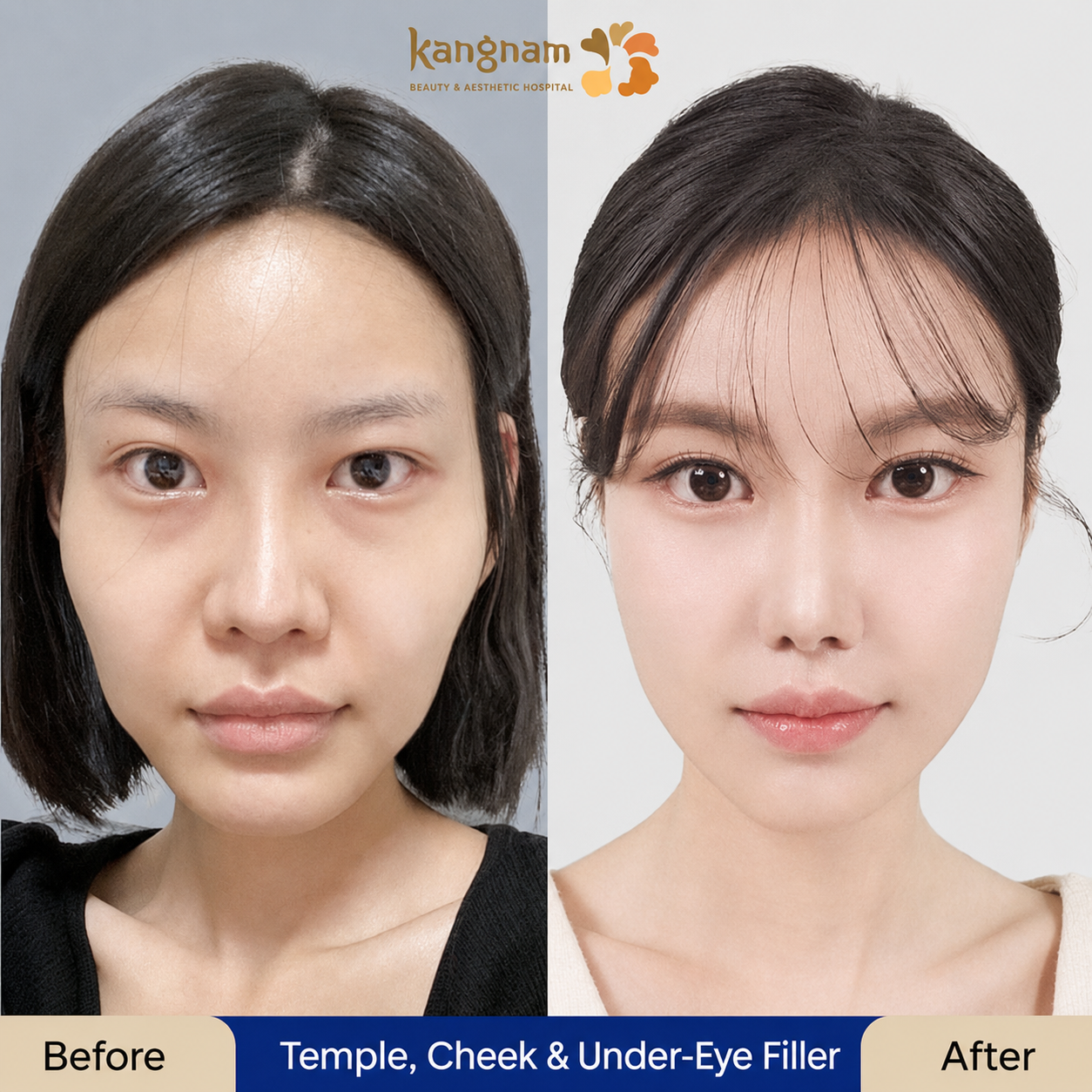
Filler may restore volume to hollow temples and improve facial contours.
| Service | Approximate cost (USD per cc) |
|---|---|
| Juvéderm filler – listed duration of up to 2 years | 456 |
| Restylane/Belotero Revive filler | 456 |
| Xcelens filler – listed duration of up to 2 years | 380 |
| E.P.T.Q Korean filler | 190 |
The USD amounts are approximate and were calculated using the reference exchange rate of VND 26,320 per USD. The actual amount may vary depending on the exchange rate applied by the bank or payment provider.
At reputable facilities such as Kangnam Aesthetic Hospital, the price of temple filler may be higher than the general market average. The service may include:
Claims that treatment causes no swelling, pain, or complications should be interpreted cautiously. Even correctly administered filler may cause temporary swelling, bruising, tenderness, or other adverse effects.
📌 Further reading: How Much Does Lip Filler Cost? – A useful reference for patients considering filler treatment in several facial areas.
The cost of temple filler depends on the degree of hollowing, the filler product, the doctor’s expertise, and the services included in the treatment package.
Patients with mild hollowing may require approximately 1–2cc of filler, resulting in a lower total cost.
Patients with deep hollows or significant asymmetry may require approximately 3–4cc or more to create a balanced result.
The exact amount should only be determined after a facial examination because excessive filler may create an unnatural or heavy appearance.
Fillers are available in different product categories, formulations, and price ranges.
Authentic fillers manufactured in France, Switzerland, South Korea, or other countries may differ in:
Some temple fillers may last approximately 12–24 months, but the duration varies depending on the exact product, injection depth, amount used, metabolism, and individual tissue response.
A higher price does not automatically guarantee a better result. The filler must be appropriate for the temple anatomy and treatment goal.
The temple is an anatomically sensitive area containing important blood vessels and nerves.
Correct injection depth and placement may reduce the risk of:
Reputable facilities commonly employ licensed medical practitioners and follow a medically standardised injection process. The cost may therefore be higher.

The doctor identifies the appropriate temple injection points before treatment.
In addition to the filler itself, the total price may include:
Some facilities may offer follow-up correction if the result remains uneven after the swelling has resolved. Patients should confirm in writing which services are included.
The following table compares temple filler injections with autologous fat grafting.
| Criterion | Temple filler injection | Autologous temple fat grafting |
|---|---|---|
| Material used | Hyaluronic acid or another injectable filler manufactured in countries such as France, Switzerland, or South Korea | Fat collected from the patient’s abdomen, thighs, arms, or another donor area |
| Level of invasiveness | Minimally invasive | Mild to moderately invasive because fat must be harvested and processed |
| Procedure time | Approximately 20–30 minutes | Approximately 60–90 minutes |
| Typical longevity | Approximately 12–24 months, depending on the filler | Potentially several years, depending on fat survival, technique, and individual response |
| Common limitations or risks | Gradual breakdown, swelling, bruising, lumps, asymmetry, vascular occlusion, or other filler complications | Partial fat absorption, swelling at the donor and recipient sites, asymmetry, fat necrosis, cysts, or irregular contour |
| Recovery | Usually relatively short | Generally longer than filler because both the donor and recipient areas must recover |
| Reversibility | Hyaluronic acid filler may be dissolved with hyaluronidase when medically appropriate | Transferred fat cannot be easily dissolved and may require another procedure for correction |
Some transferred fat may be absorbed during the first several months. The percentage varies widely and cannot be predicted precisely for every patient.
📌 You may also be interested in: Autologous fat grafting may be considered by patients who prefer using their own tissue and want a potentially longer-lasting option.
Patients should not select temple filler solely because the advertised price is unusually low.
Low-cost services may involve:
Incorrect injection may cause:
The temple is considered a higher-risk injection area because its vascular anatomy may communicate with vessels supplying the eye.
Although filler is a minimally invasive treatment, it must still follow appropriate medical standards.
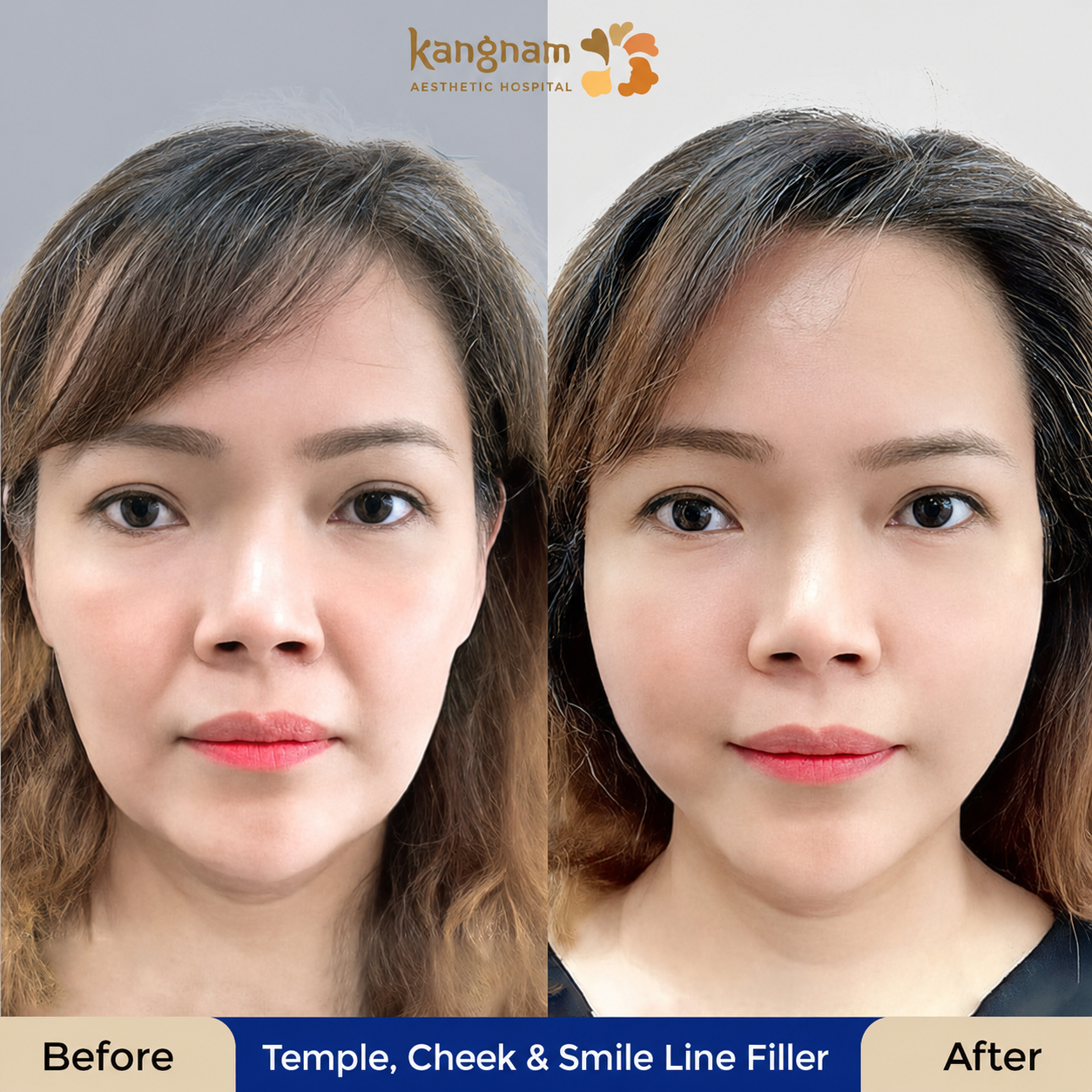
The face may appear softer and more proportionate after filler is placed in the temples, cheeks, or facial folds.
Kangnam provides filler treatment performed by dermatologists or qualified aesthetic doctors using traceable products and sterile procedures.
Each patient undergoes an assessment so that the doctor can determine:
📌 Do not miss: Are Dermal Fillers Good for You? – Learn more about filler benefits, durability, and potential complications.
Kangnam Aesthetic Hospital offers filler services designed to suit overseas Vietnamese patients with limited time in Vietnam.
Treatment is performed by qualified medical practitioners using traceable products, with transparent pricing and an individualised facial treatment plan.
Kangnam uses filler products such as Juvéderm, Xcelens, and E.P.T.Q.
Patients should be able to inspect:
Claims regarding FDA or CE authorisation should apply to the exact product and intended indication. Regulatory status should not be assumed solely from a brand name.
The filler procedure generally takes approximately 15–30 minutes.
Many patients can resume light activities soon afterward, making the treatment convenient for overseas Vietnamese patients visiting Vietnam for a limited period.
However, patients should allow time for:
It is preferable not to schedule filler immediately before a long flight or important event.
Service prices are listed clearly so that patients can select a treatment plan based on their budget and desired facial improvement.
Patients should request a written quotation confirming:
Kangnam’s dermatology team assesses:
The temple is located close to important blood vessels. Therefore, injection depth, filler volume, pressure, and speed must be carefully controlled.
Experienced doctors may reduce the risk of vascular occlusion, bruising, asymmetry, and delayed complications, but no practitioner can guarantee that all risks will be eliminated.

Kangnam’s dermatology doctors have experience in facial filler assessment and injection.
At a reputable facility offering a comprehensive service package, the listed temple filler price may include:
However, additional costs may arise in certain cases.
These may include:
Patients should not automatically receive additional filler simply because the first result appears uneven during the first few days. Swelling must be allowed to settle before the outcome is reassessed.
Temple filler is a relatively quick and minimally invasive aesthetic treatment that may make the face appear softer, fuller, and more youthful.
However, the price is not fixed. It depends on the degree of hollowing, type and amount of filler, doctor’s expertise, and included services.
To reduce the risk of complications, patients should choose a licensed facility, a qualified medical practitioner, and an authentic filler product.
Overseas Vietnamese patients may submit photographs for a preliminary comparison between temple filler and autologous fat grafting before returning to Vietnam. However, the final recommendation and injection volume must be confirmed through an in-person medical examination.