Date posted: 05-10-2026 | Last updated : 05-10-2026
To operate legally in Vietnam, an aesthetic hospital or specialized aesthetic hospital must have a Certificate of Business Registration, a License for Medical Examination and Treatment issued by the competent authority, and an approved list of specialized medical techniques.
A License for Medical Examination and Treatment is the most important legal document confirming that a healthcare facility is authorized to provide medical services within its licensed scope.
The hospital must have an appropriate scope of professional practice and an approved list of specialized techniques. Having a hospital license does not automatically mean that the facility is authorized to perform every type of cosmetic surgery.
Doctors and healthcare professionals directly involved in providing medical services must have a valid practicing license and appropriate practice registration for their professional duties.
For private hospitals, the legal documents of the owning entity, such as business registration or investment-related documents, form part of the legal documentation required for operation.
Requirements concerning operating rooms, anesthesia and resuscitation, medical equipment, infection control, and qualified personnel have a direct impact on surgical safety.
Requirements related to fire prevention and firefighting, environmental protection, radiation safety, or specialized medical equipment may also apply depending on the facility’s scale and actual operations.
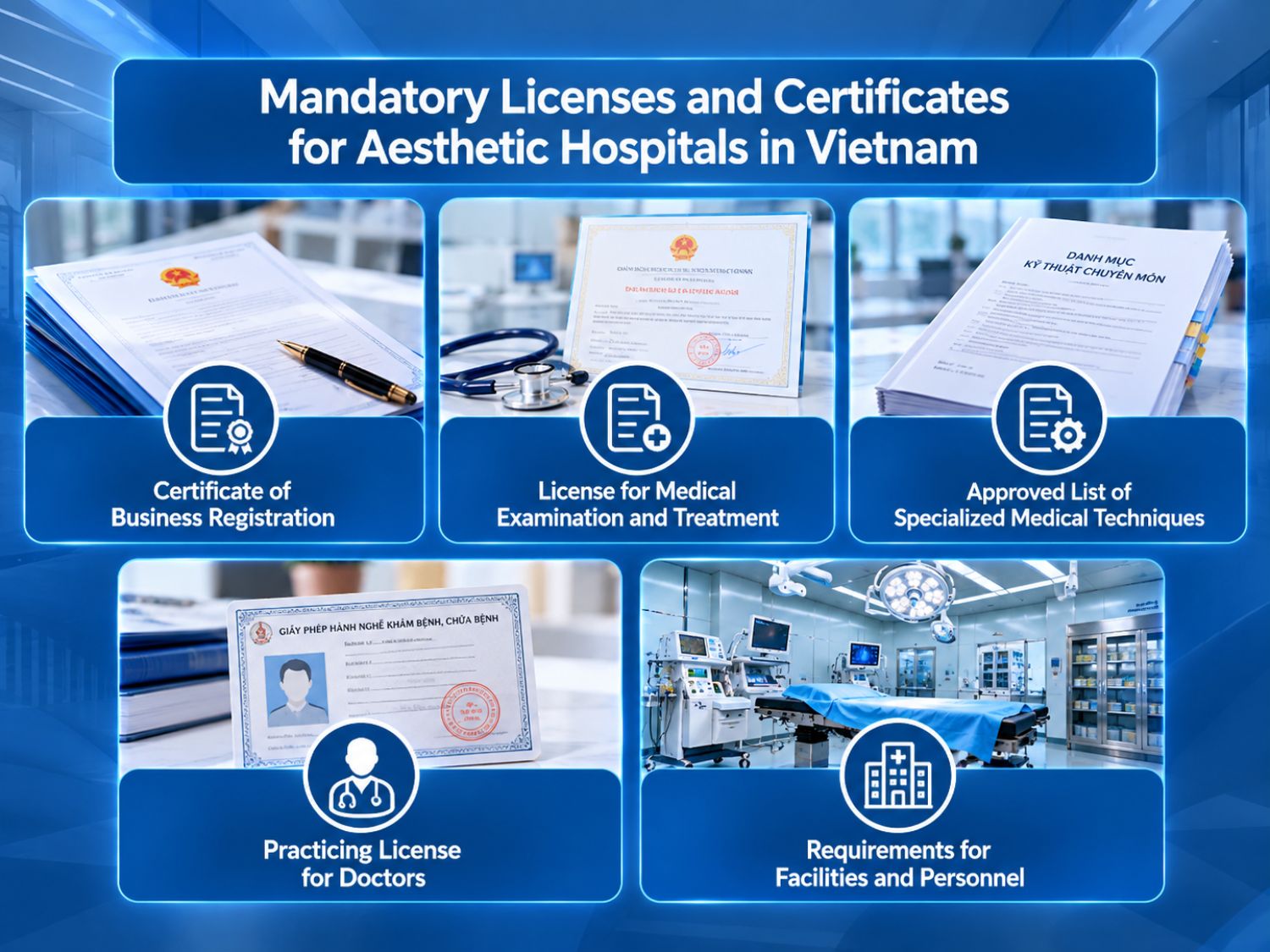
1. Mandatory Licenses and Certificates for Aesthetic Hospitals in Vietnam
An aesthetic hospital must meet multiple legal requirements simultaneously, with the most important being a medical examination and treatment license and the professional licensing requirements applicable to healthcare personnel. Other documents relating to business registration, fire safety, environmental protection, or radiation safety may apply depending on the type and actual activities of the facility.
- Certificate of Business Registration: Confirms the legal entity, registered name, address, and business registration details of the organization.
- License for Medical Examination and Treatment: Establishes that the facility is authorized to provide medical examination and treatment services within its approved professional scope.
- Approved List of Specialized Medical Techniques: Specifies the procedures and techniques that the hospital is authorized to perform, such as breast augmentation, liposuction, rhinoplasty, or other cosmetic surgeries. Having a medical operating license does not mean that the facility is automatically authorized to perform every technique.
- Practicing License for Doctors: Doctors who directly examine, diagnose, prescribe, or perform surgery must hold a valid practicing license with a scope of practice appropriate to their professional duties.
- Requirements for Facilities and Personnel: The hospital must maintain appropriate professional staffing, operating rooms, recovery and resuscitation facilities, infection control measures, and other requirements corresponding to its licensed scope of practice.
Please note that practicing certificates issued under regulations applicable before January 1, 2024, may continue to be used as practicing licenses during the applicable transition period, until they are converted in accordance with the relevant regulations.
2. What does a License for Medical Examination and Treatment mean?
A License for Medical Examination and Treatment confirms that a healthcare facility meets the legal and professional requirements to provide medical services within its licensed scope. This is one of the key documents that customers should prioritize when researching an aesthetic hospital in Vietnam.
For customers, this can be understood simply as follows:
- Being called an “aesthetic hospital” is not sufficient to prove that the facility is authorized to perform every type of procedure. Customers should check the facility’s license and approved scope of professional practice.
- The license must be associated with the specific facility and operating location. Customers should not rely solely on images of legal documents posted online if the information cannot be independently verified.
- A hospital’s operating license and a doctor’s practicing license are two separate matters. Both should be considered when assessing the safety and eligibility of a cosmetic surgery procedure.
3. Does an aesthetic hospital need an approved list of specialized medical techniques?
Yes. A hospital must perform procedures that fall within its approved scope of professional practice and list of authorized medical techniques. This is an important basis for determining whether a facility is qualified to perform the specific cosmetic surgery a customer is considering.
Before choosing a service, customers can ask:
- Does the planned procedure fall within the facility’s approved scope of professional practice?
- Will the surgery be performed at the specific location authorized under the facility’s license?
- Does the doctor performing the surgery directly hold an appropriate scope of practice?
- Does the facility have adequate anesthesia, resuscitation, and emergency care capabilities for the procedure?
Checking these factors can help customers avoid choosing a service based solely on the name or advertising of a procedure while overlooking the facility’s actual authorized scope of practice.
4. What professional requirements must doctors at aesthetic hospitals meet?
Doctors and healthcare professionals working at aesthetic hospitals must meet the applicable professional licensing requirements and perform medical services within their authorized scope of practice. Customers should clearly identify the doctor who will perform the surgery directly, as well as the personnel responsible for other relevant clinical procedures.
Before surgery, customers should be provided with clear information about:
- The doctor who will directly perform the surgery and their relevant qualifications.
- Whether the doctor’s scope of practice is appropriate for the planned procedure.
- The personnel responsible for anesthesia or local anesthesia when required for the procedure.
- The personnel responsible for monitoring and postoperative care.
For international patients and overseas Vietnamese, identifying the doctor who will directly perform the surgery is particularly important because consultation and preoperative preparation are often arranged remotely.
5. Do aesthetic hospitals need to meet requirements for operating rooms and anesthesia and resuscitation?
Yes. For surgeries requiring general anesthesia or postoperative monitoring, the facility must meet the relevant professional requirements regarding surgical areas, equipment, anesthesia and resuscitation personnel, emergency care, and patient monitoring.
Customers should pay attention to:
- The surgical area: It should be organized in accordance with professional requirements and infection-control standards.
- Surgical and anesthesia equipment: Equipment should be appropriate for the specific type of procedure being performed.
- Qualified personnel: Staff should be capable of monitoring patients and responding to unexpected situations during surgery.
- Emergency and referral procedures: The facility should have procedures for managing emergencies and transferring patients when a situation exceeds its professional capabilities.
- Postoperative monitoring and care: Customers should understand how they will be monitored and cared for after surgery.
6. How should customers verify an aesthetic hospital’s licenses?
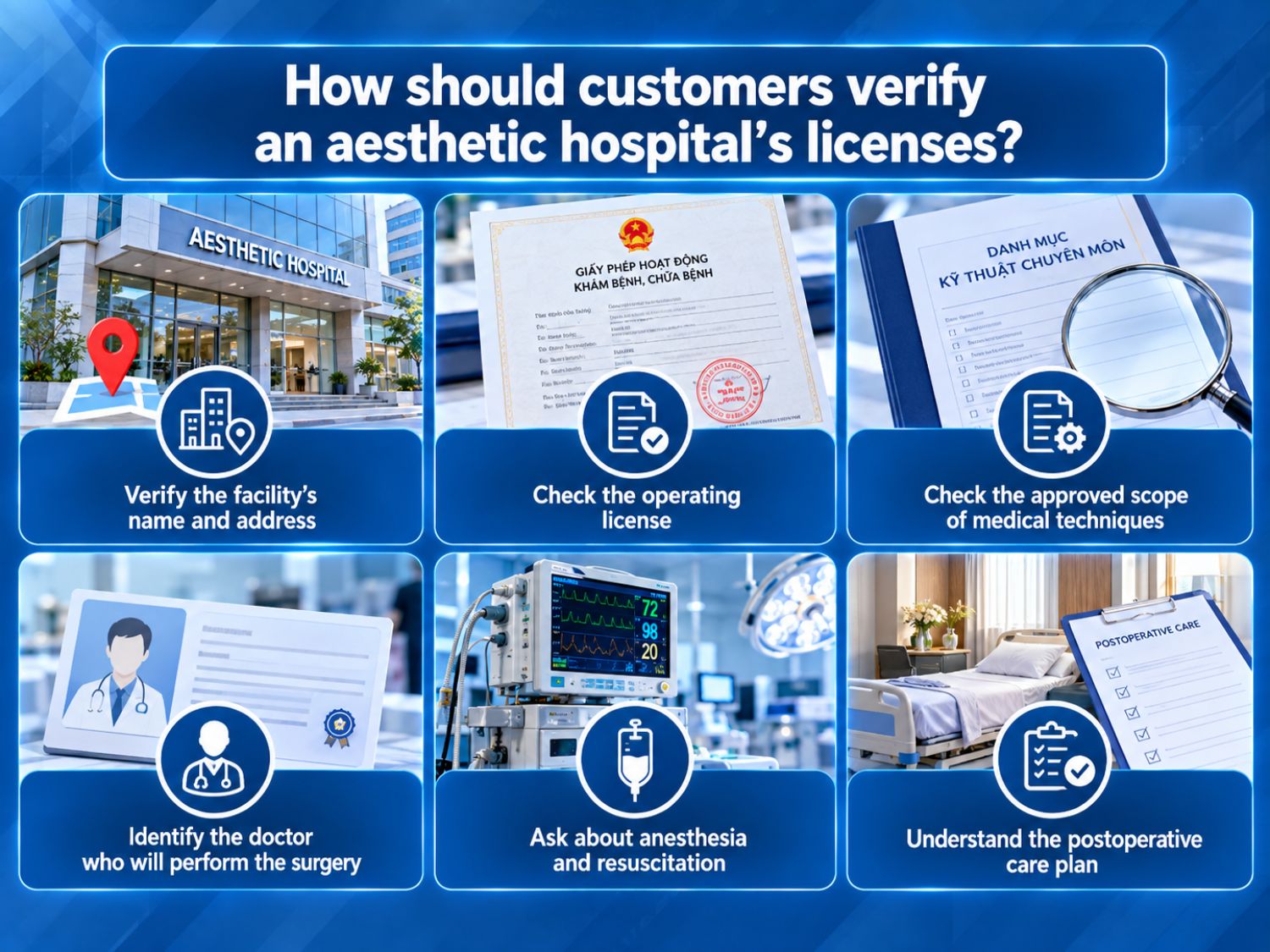
Before scheduling surgery, customers should verify the License for Medical Examination and Treatment, approved scope of medical techniques, doctor who will perform the surgery, anesthesia and resuscitation arrangements, and postoperative care plan.
Key points to check include:
- Verify the facility’s name and address: Make sure the information on the license corresponds to the location where the surgery will actually take place.
- Check the operating license: Confirm that the facility is licensed to provide medical examination and treatment services.
- Check the approved scope of medical techniques: Ask whether the planned procedure falls within the facility’s authorized professional scope.
- Identify the doctor who will perform the surgery: Do not rely solely on the brand name of the hospital or the consultant providing information.
- Ask about anesthesia and resuscitation: For procedures involving general anesthesia, customers should know who is responsible and what emergency arrangements are available.
- Understand the postoperative care plan: Ask about the monitoring period, follow-up schedule, and support available if complications or unusual symptoms occur after returning home or traveling back to another country.
7. Does Kangnam Aesthetic Hospital meet the legal and professional requirements?
According to the information provided, Kangnam Aesthetic Hospital operates as a hospital licensed by the Ministry of Health, with medical examination and treatment operating licenses and separately licensed facilities in different locations.
Some notable information includes:
- Medical examination and treatment operating licenses: Kangnam Aesthetic Hospital was issued operating license No. 194/BYT-GPHĐ in Hanoi on October 21, 2025, and license No. 287/BYT-GPHĐ in Saigon on December 3, 2020.
- Hospital-based operations: Kangnam operates specialized departments covering facial aesthetics, maxillofacial surgery, body contouring, rejuvenation and dermatological treatment, and aesthetic dentistry. Surgical procedures are performed at licensed hospital facilities.
- Surgical facilities: Kangnam has sterile operating rooms, surgical equipment, and postoperative monitoring areas. These factors should be considered together with the facility’s approved scope of medical techniques when assessing whether it is appropriately equipped to perform surgery.
- Specialist doctors: Surgical procedures are performed by specialist doctors at licensed hospital facilities.
8. Frequently Asked Questions About Aesthetic Hospital Licensing in Vietnam
Are aesthetic hospitals required to have an operating license?
Yes. Healthcare facilities must obtain an operating license in accordance with applicable regulations and may only provide services within their authorized professional scope.
Does having a hospital operating license mean that the facility can perform every type of cosmetic surgery?
No. The facility must also meet the professional requirements and authorized scope of medical techniques applicable to each specific service or procedure.
Do aesthetic surgeons need a practicing license?
Yes. Healthcare professionals providing medical examination and treatment services must meet the applicable professional licensing requirements and perform their duties within their authorized scope of practice.