
✕

Are implants and devices used in Vietnam FDA/CE approved?

Date posted: 06-10-2026 | Last updated : 06-10-2026

Implant materials approved or cleared by the FDA for use in Vietnam does not mean that a product is legally permitted for use simply because it has FDA or CE certification. FDA and CE are regulatory frameworks in the United States and the European Union, respectively, while implantable medical devices used in Vietnam must comply with Vietnam’s medical device regulations. When choosing an implant, patients should check the product name, manufacturer, model, marketing status in Vietnam, and relevant FDA/CE documentation if provided by the medical facility.

FDA and CE are not universal licenses that can replace the regulatory procedures required in Vietnam.

A product with FDA clearance/approval or one that meets CE requirements must still comply with Vietnamese regulations if it is imported, marketed, and used in Vietnam.

Not every medical device has an “FDA certificate.” The FDA clearly distinguishes between facility registration, device listing, approval, clearance, and authorization.

CE marking indicates conformity with the European Union’s legal framework; it is not a license issued by a single EU authority for all medical devices.

Before undergoing an implant procedure, patients should verify the product name, manufacturer, model, origin, marketing status in Vietnam, and relevant documentation, rather than relying solely on terms such as “FDA approved” or “CE certified.”

1. The Role of FDA and CE Certifications in Vietnam

FDA and CE are important references for assessing the standards and regulatory status of medical devices in the United States and European markets. However, they do not replace the procedures required for a product to be legally marketed in Vietnam.
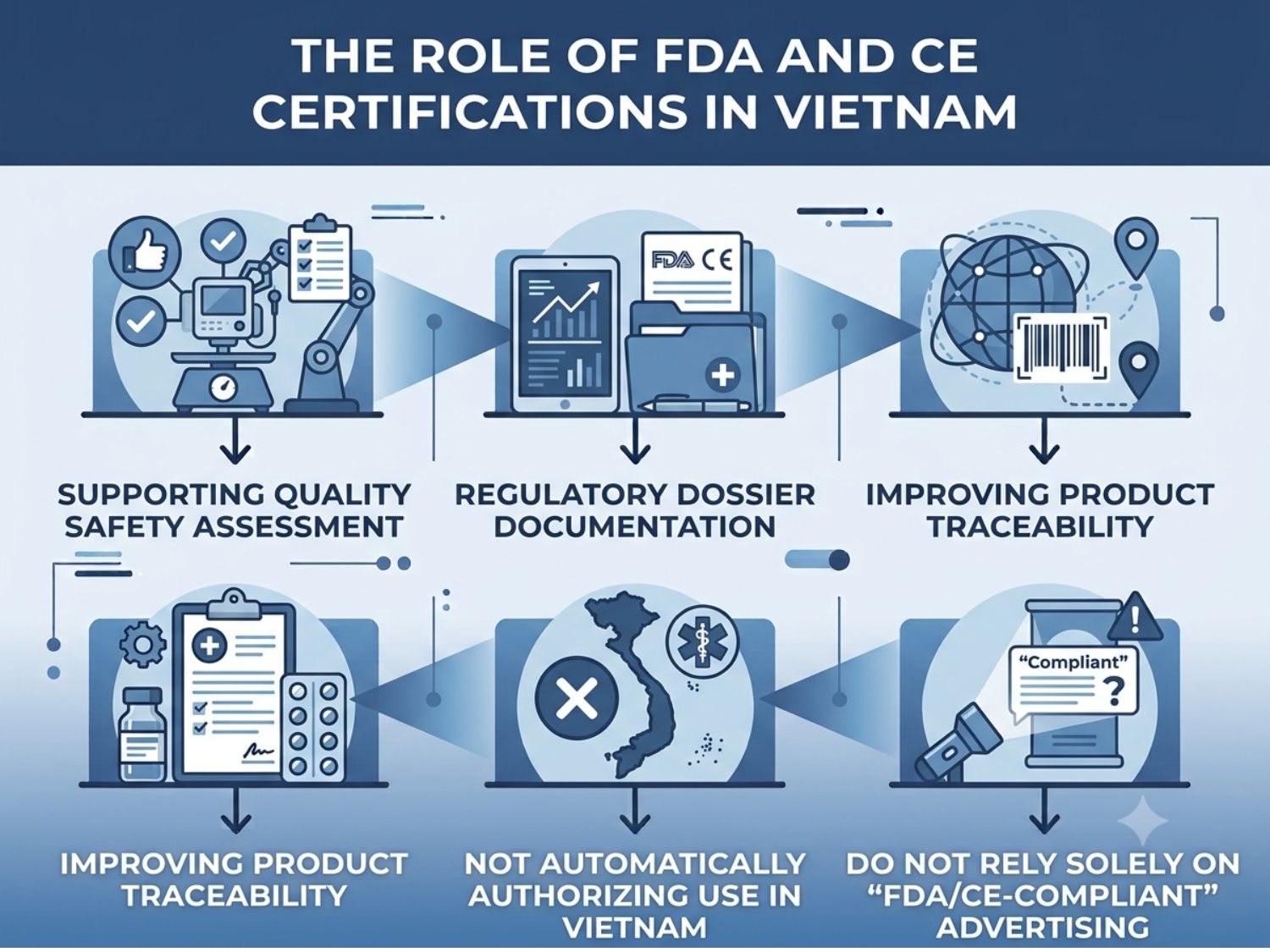
  • Supporting quality and safety assessment: FDA or CE information gives healthcare facilities and customers additional grounds to assess whether a product has met the applicable regulatory requirements in the United States or Europe.
  • Serving as documentation in regulatory dossiers: Depending on the type of medical device and the applicable procedures, foreign market authorization certificates and related documents may be included in dossiers for the registration, importation, or marketing of medical devices in Vietnam.
  • Improving product traceability: For implants such as breast implants, other implantable devices, or surgical devices, FDA/CE information can help verify the manufacturer, model, intended use, and regulatory status of the product.
  • Not automatically authorizing use in Vietnam: Products with FDA or CE certification must still comply with Vietnam’s medical device regulations before they can be legally marketed and used in the country.
  • Do not rely solely on “FDA/CE-compliant” advertising: Patients should verify that the certification applies to the correct product, model, and manufacturer, and should also check the documentation confirming the product’s legal circulation in Vietnam.

Five essential factors covered during a pre-anesthesia assessment to ensure surgical safety.

In practice, the FDA clearly states that registering a facility with the FDA and listing a device in its system does not mean that the device has received FDA approval, clearance, or authorization. Depending on the type of device, the FDA has different premarket regulatory pathways, including 510(k), Premarket Approval (PMA), and De Novo.

FDA – Device Approvals and Clearances

2. What Types of Implant Materials Are Commonly Used in Practice?

In plastic surgery, a wide range of implant materials may be used, including breast implants, nasal implants, chin implants, facial implants, and bone fixation materials. Common categories include:
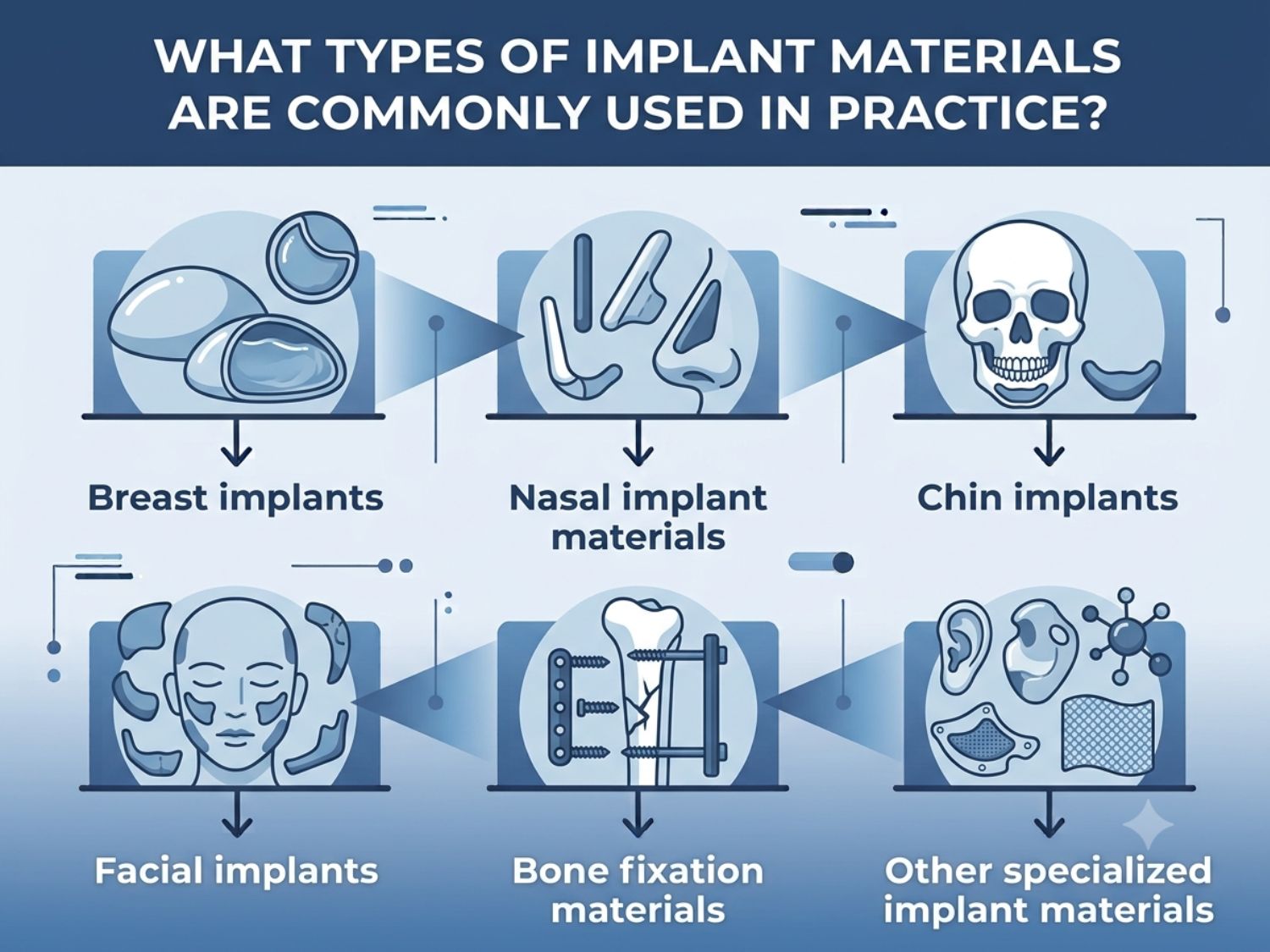
  • Breast implants: Typically silicone gel-filled implants available in various sizes, shapes, and surface characteristics depending on the specific product.
  • Nasal implant materials: These may include silicone, ePTFE (Gore-Tex), or other synthetic materials. Surgeons may also use autologous tissue, such as ear or rib cartilage, although these are not artificial implants.
  • Chin implants: Commonly made from materials such as silicone or ePTFE, with the shape and size selected according to the patient’s facial structure.
  • Facial implants: In some cases, specialized implants may be used for cheekbone or jawline augmentation, or to restore volume in areas with deficiencies.
  • Bone fixation materials: In maxillofacial surgery, titanium plates and screws may be used to stabilize bones after osteotomy and repositioning procedures.
  • Other specialized implant materials: Depending on the type of surgery, meshes, plates, or tissue-support materials may be used for specific clinical indications.

Common types of implant materials used in plastic surgery and orthopedic practice.

Medical devices in Vietnam are regulated under Vietnamese law based on their risk level and device classification. Decree No. 98/2021/ND-CP established a regulatory framework covering the classification, manufacture, circulation, sale, importation, and use of medical devices. Class C and Class D medical devices are subject to specific marketing authorization procedures.

Decree No. 98/2021/ND-CP and information on medical device management – Government Portal

3. What Documents Should Patients Check Before Undergoing an Implant Procedure?

Patients should verify the product’s identification details, origin, manufacturer, marketing status in Vietnam, and documentation demonstrating that the product is suitable for its intended use.

Before undergoing the procedure, patients can proactively ask the medical facility to provide or clarify the following information:
  • Trade name and product name: The specific names should be clearly stated rather than relying on generic descriptions such as “premium implants,” “American materials,” or “European medical devices.”
  • Manufacturer and country of manufacture: This information helps patients cross-check the product documentation and reduces the risk of confusing different device lines.
  • Model, product code, or catalogue number: These details are essential for verifying whether the device is actually the product being advertised.
  • Marketing status in Vietnam: For products subject to marketing authorization requirements, patients should ask for the relevant marketing authorization number and identify the entity responsible for introducing the product to the Vietnamese market.
  • FDA- or CE-related documentation, if advertised: If the facility promotes a product as “FDA approved” or “CE certified,” patients can request specific documentation to determine whether it has FDA approval, clearance, CE marking, or another form of registration.
  • Post-implantation traceability information: For certain devices, retaining the product name, model, batch number, or other identifying information facilitates long-term follow-up and helps address potential issues.

4. Why Should Patients Avoid Choosing Implant Materials Based Solely on “FDA” or “CE” Status?

Patients should not choose implant materials solely because a product has FDA or CE status, as this is not the only factor determining whether the material is suitable and safe for an individual surgical procedure. Selection also depends on the product’s regulatory status in Vietnam, its origin, material properties, and the surgeon’s clinical assessment.

  • FDA/CE status does not replace Vietnamese regulations: Products must still meet the applicable domestic requirements for the marketing, importation, and use of medical devices.
  • Verify the exact product: Patients should not rely solely on a brand’s claims of FDA/CE compliance. They should confirm that the certification or authorization applies to the specific model, manufacturer, and intended use.
  • Different materials have different properties: Silicone, ePTFE, breast implants, and other implant types have distinct structures and indications. No single material is suitable for every patient.
  • The surgeon’s clinical assessment is essential: The surgeon should select an appropriate material based on the patient’s anatomy, tissue quality, surgical history, and aesthetic goals.
  • The product’s origin must be traceable: Patients should check product labels, batch/serial numbers, manufacturer details, and traceability documents, rather than relying solely on an FDA or CE logo.

5. How Can Patients Verify Whether an Implant Is Legally Marketed in Vietnam?

The most reliable approach is to identify the exact product and cross-check it against Vietnam’s medical device regulatory system or ask the medical facility to provide the relevant regulatory documentation.

Step 1: Identify the exact product.

Record the trade name, manufacturer, model, product code, and country of manufacture.

Step 2: Ask about its regulatory status in Vietnam.

Instead of simply asking, “Does it have FDA certification?”, ask whether the product has a marketing authorization number, a declaration of applicable information, or another relevant form of regulatory documentation in Vietnam.

Step 3: Cross-check FDA or CE information if the facility advertises it.

If a product is promoted as FDA-approved, patients can search for the product or manufacturer in the relevant FDA database. The FDA also advises users to distinguish facility registration and device listing from actual approval or clearance.

Step 4: Verify the information in the medical facility’s records.

The product recommended during the consultation, the product actually used, and the information recorded in the medical documentation should be consistent.

Step 5: Keep the implant information after the procedure.

Patients should retain the relevant documents, product identification details, and surgical records to facilitate follow-up appointments and the management of any future complications or concerns.

FDA-certified rhinoplasty materials

6. Related Questions

Is CE equivalent to FDA?

FDA and CE should not be considered equivalent certifications. They belong to two different regulatory systems that operate under different legal frameworks. A product authorized for marketing in the United States does not necessarily meet the requirements for marketing in the European Union, and vice versa.

Should patients ask to see FDA documentation before undergoing an implant procedure?

Patients can request specific information about a product’s regulatory status if the facility cites FDA status as evidence of quality. However, the more important considerations are verifying the exact product, the correct model, and its marketing status in Vietnam, rather than simply reviewing a document bearing the FDA name.


Top 5 Leading Aesthetic Plastic Surgeons in Vietnam

Top 3 most reputable plastic surgery clinics in Vietnam

Messenger