



- Prepare before leaving Vietnam — the check-up, records, medication and instructions you need.
- Understand how remote follow-up works once you are back home, step by step.
- Recognise the warning signs that need local medical care — and when to return to Vietnam.
Short answer
Follow-up after you return home from Vietnam includes caring for your own wounds, taking your prescribed medication, attending routine follow-up appointments after about 1–2 weeks, and watching for unusual signs. The exact follow-up schedule varies with the type of surgery, your health and how quickly you recover.
- Before leaving Vietnam: your doctor assesses your recovery and fitness to travel, and you receive full surgical information, prescriptions, care instructions and a follow-up schedule.
- Remote monitoring: recovery progress can be updated via photos, videos or online consultations, following the hospital's plan.
- Handling complications: if signs of infection, bleeding, severe pain or shortness of breath occur, seek medical attention at a local healthcare facility in your home country immediately.
- Follow-up visits: the schedule for check-ups, suture removal and outcome reviews depends on the type of surgery and your recovery.
1. What to prepare before leaving Vietnam
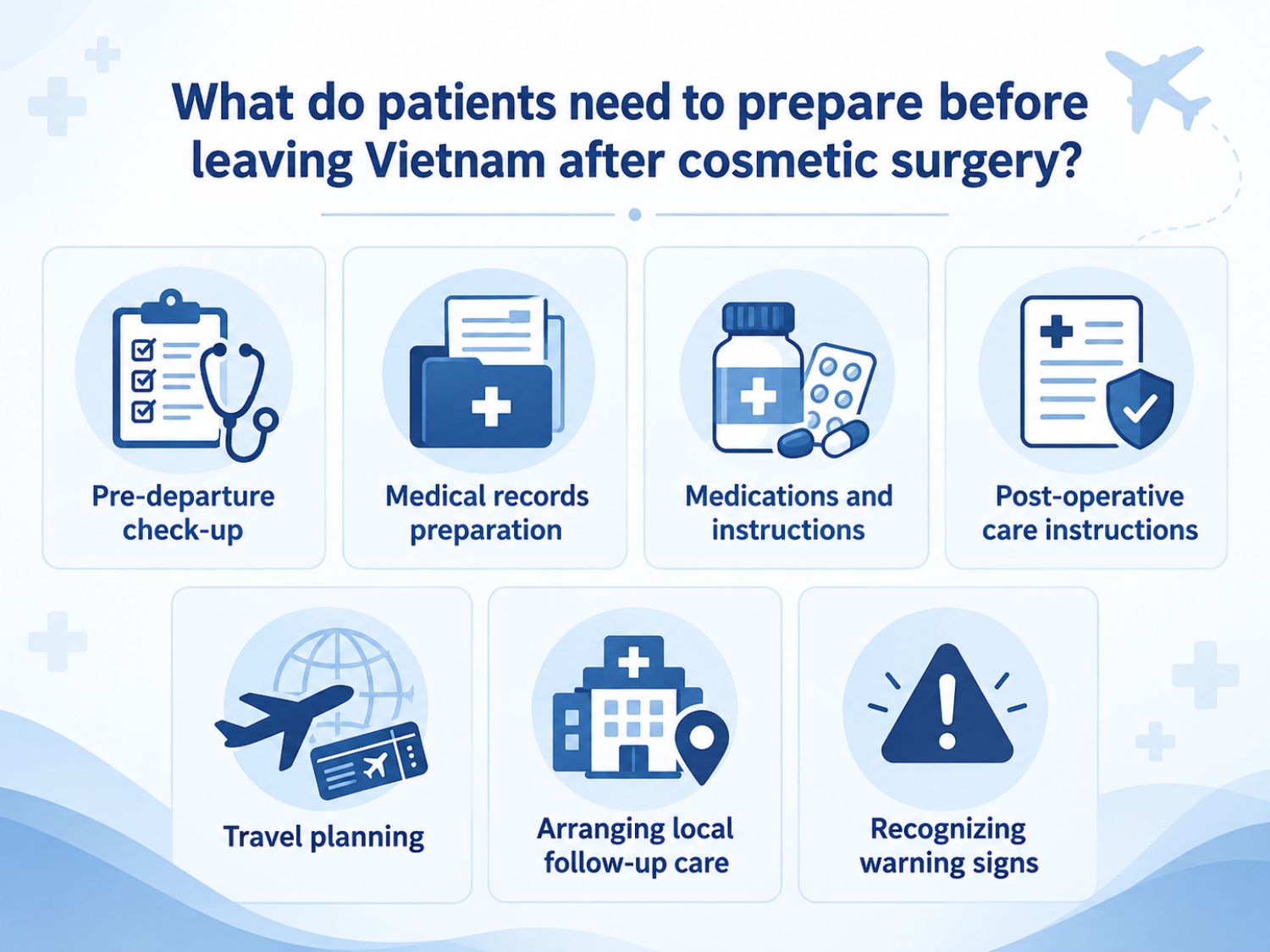
Before you leave Vietnam after cosmetic surgery, you need a follow-up check to confirm your recovery, plus your medical records, prescribed medication, home-care instructions and a monitoring plan for after you return. Above all, a doctor must assess whether you are fit to fly, to minimise the risk of complications in transit. Things to prepare:
- Pre-departure check-up: the doctor examines the incision, swelling, pain level and healing progress, and confirms a safe time to travel.
- Medical records: carry your discharge papers, surgical summary, relevant test results and implant information, if applicable.
- Medication and instructions: bring enough of your prescribed medication and make sure you understand the doses, schedule and what to do if you miss a dose.
- Post-operative care instructions: know how to clean your wounds, change dressings, wear compression garments and follow movement restrictions as directed.
- Travel planning: discuss the flight length with your doctor, the risk of deep vein thrombosis (DVT) from prolonged sitting, moving during the flight and avoiding heavy lifting.
- Local follow-up care: find a healthcare facility with the right specialty in your home country in case you need an examination, and save the contact details of your hospital in Vietnam.
- Warning signs before departure: fever, increasing pain, bleeding from the incision, spreading redness or unusual discharge must be assessed before you fly.
2. How remote monitoring works after you return home
Remote follow-up usually means regular contact with your doctor by video call, sending photos of the surgical site, updating your recovery progress and receiving home-care instructions. When necessary, the doctor will recommend an in-person examination at a medical facility in your home country. The process usually runs like this:
Set up contact channels
The hospital gives you contact details for your doctor or the post-operative care team — by phone, Zalo, email or video call.
Update your recovery
Send photos of the surgical site and report pain, swelling, bruising and any ongoing symptoms at the scheduled times.
Remote assessment by the doctor
From your photos and information, the doctor assesses healing, answers your questions and gives tailored care advice.
Adjust your care instructions
You receive advice on wound hygiene, prescribed medication, daily routine and when to resume physical activity.
Coordinate local check-ups
If unusual signs appear or a direct examination is needed, the doctor guides you to a suitable local facility and provides medical records as needed.
Track long-term results
Keep sending photo updates and recovery reports at the milestones your doctor sets, so the final result can be evaluated.
3. Incision care and medication at home
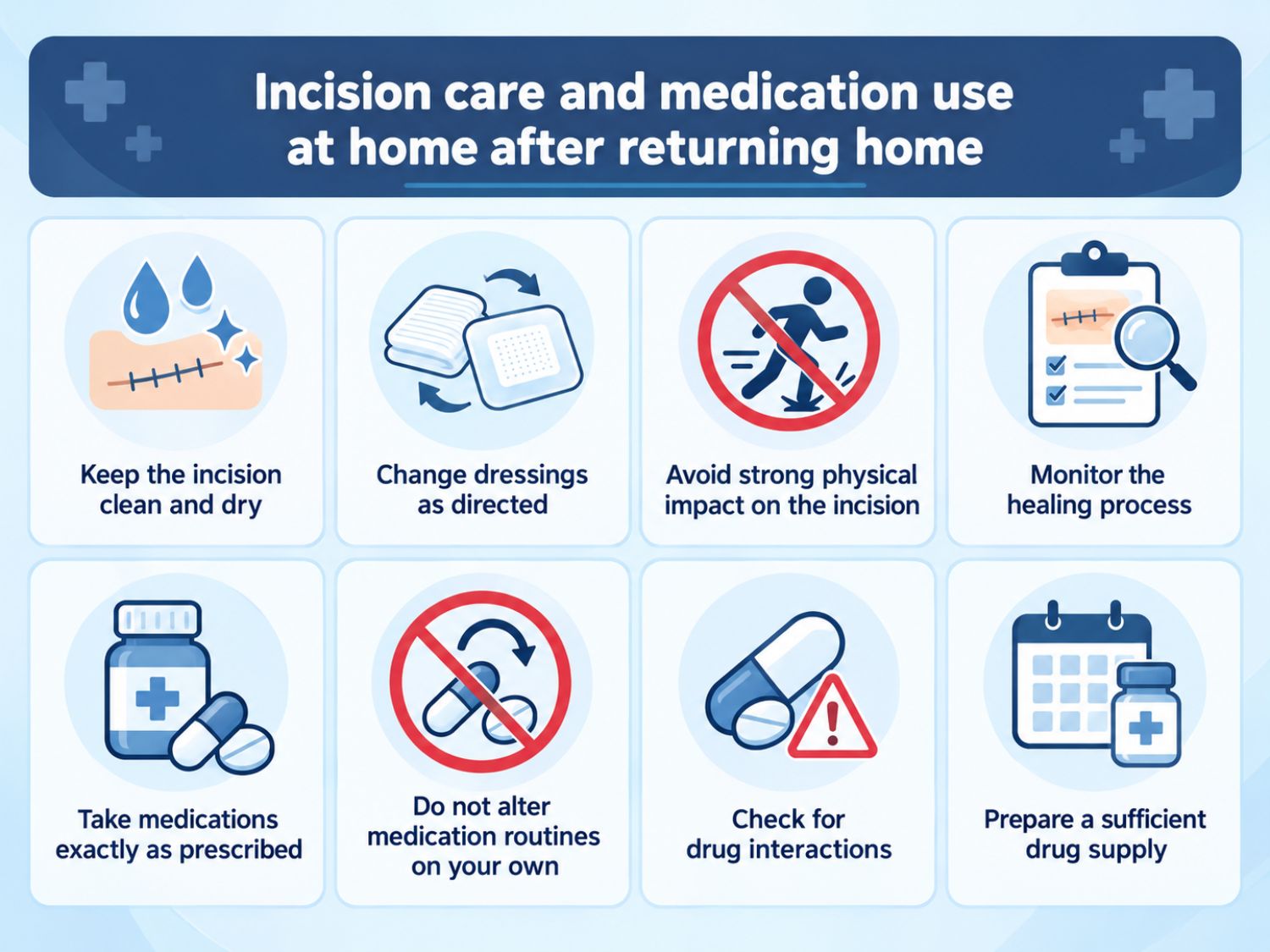
Once home, care for your incision as instructed, keep the surgical area clean, take your prescribed medication and watch for unusual signs. Keep in touch with your doctor in Vietnam and have follow-up examinations at a local facility when indicated:
- Keep the incision clean and dry: clean the wound with the solution your doctor specified; avoid soaking it in water or exposing it to unhygienic environments.
- Change dressings as directed: wash your hands first, use clean gauze and do not remove dressings without permission.
- Avoid pressure on the incision: don't scratch, rub or pick scabs, and don't apply cosmetics or scar creams until the wound has healed.
- Monitor healing: watch for swelling, redness, pain and discharge; take photos and send them to your doctor as scheduled if requested.
- Take medication exactly as prescribed: follow the doses and schedule for painkillers, antibiotics or other prescribed medicines.
- Don't change your medication on your own: avoid increasing doses, stopping medication or buying additional drugs without consulting your doctor.
- Check for drug interactions: tell your doctor about medication for underlying conditions, dietary supplements or any history of drug allergies.
4. Warning signs that need immediate care at home
After cosmetic surgery, seek immediate care at a local healthcare facility in your home country if you develop a high fever, abnormally worsening pain, persistent bleeding, spreading redness or foul-smelling discharge. Warning signs to watch for:
- Fever of 38°C (100.4°F) or higher: especially with chills, severe fatigue or signs of infection at the surgical site.
- Sudden increase in pain: pain that keeps getting worse and doesn't improve with your prescribed painkillers.
- Redness, warmth or pus at the surgical site: spreading redness, cloudy discharge or a foul odour can be signs of infection.
- Abnormal bleeding: blood continuously soaking through dressings and not settling when managed as instructed, or a tense, swollen lump appearing quickly (haematoma).
- Wound dehiscence: the edges of the incision separate, exposing tissue underneath, or there are clear signs of delayed healing.
- Abnormal skin colour around the surgical area: dark purple, pale or cold skin, or dark, necrotic patches need early medical assessment.
- Swelling and pain in one leg: particularly with warmth, redness or tightness in the calf, which may be linked to deep vein thrombosis (DVT).
Call emergency services immediately
If you have shortness of breath, chest pain or fainting, call emergency services straight away — these may be signs of a life-threatening complication such as pulmonary embolism (PE). Do not wait for a remote check-in.
5. When to seek an in-person follow-up or return to Vietnam
Have an in-person follow-up examination if you develop unusual symptoms, your wound is slow to heal, your recovery isn't going as expected, or a routine check-up is scheduled by your surgeon. Situations that need attention:
- Unusual signs: redness, worsening pain, discharge, bleeding or signs of infection at the incision need an immediate in-person assessment in your home country.
- Delayed wound healing: incisions that take a long time to close, opened sutures or areas of abnormal skin colour need a doctor's assessment.
- Recovery not as expected: prolonged swelling at the surgical site, noticeable asymmetry, or unusual changes in appearance or function.
- Scheduled routine follow-ups: some procedures need in-person check-ups after a few weeks or months to assess healing and the final result.
- Further treatment or revision: you may be advised to return to Vietnam if procedures related to the original surgery are needed and you are fit to travel.
- Remote assessment isn't enough: when photos, video calls or the information you provide can't establish how you are recovering, the doctor may recommend an in-person examination.


Dr. Harvey Nguyen
Medical Director, Kangnam Aesthetic Hospital (Ho Chi Minh City) · Specialist Level I in General Surgery, Hanoi Medical University · Licensed Plastic & Aesthetic Surgeon.
Member of VSAPS and ASAPS · trained in the USA, South Korea and Japan · reviewed this page on 12/11/2026. View full profile →
6. Frequently asked questions
Can I continue to be monitored by my doctor in Vietnam after returning home?
Yes, provided the hospital offers remote post-operative support. You can send updates via photos, videos or online consultations at the scheduled times. However, if unusual symptoms develop, you must still visit a local medical facility in your home country for a direct examination.
What should I do if my incision becomes red, swollen or leaks fluid while I am abroad?
Contact the nearest medical facility immediately for an assessment, especially if the redness and swelling increase, pain worsens, pus is present or you also have a fever. At the same time, notify your hospital in Vietnam and provide your medical and surgical records so the doctors have the full clinical picture.
Do I need to return to Vietnam to have my sutures removed?
Not in all cases. Sutures can be removed at a suitable healthcare facility in your home country if your surgeon confirms this option is appropriate. The timing of suture removal depends on the surgical site and how the wound is healing.
- Centers for Disease Control and Prevention (CDC) — CDC Yellow Book: Medical Tourism. cdc.gov
- Kangnam Aesthetic Hospital — complication signs to watch for when flying home after surgery. kangnamaesthetichospital.com
- Kangnam Aesthetic Hospital system data — facilities and licences (Hanoi 194/BYT-GPHĐ · HCMC 287/BYT-GPHĐ). benhvienthammykangnam.com.vn
The follow-up protocol above is a general guide, not a fixed schedule: the timing of check-ups, suture removal and outcome reviews varies with the procedure, your health and how quickly you recover. This page is general information and does not replace a consultation or an in-person examination.
More on recovery and travelling home
Part of the international patient guide →