Date posted: 18-11-2026 | Last updated : 19-11-2026
Clear aligner orthodontic treatment in Vietnam can be monitored remotely when clients move abroad, particularly if their teeth are moving according to plan and their orthodontist has already established a treatment plan. Patients undergoing orthodontic treatment can periodically submit photographs of their teeth through an application or online platform so that their orthodontist can assess treatment progress. If they plan to settle abroad permanently, they may look for an orthodontist in their country of residence who agrees to take over their orthodontic case and treatment records.
Remote Monitoring: Orthodontists in Vietnam can assess dental photographs submitted periodically and provide guidance during appropriate stages of treatment.
For Invisalign Patients: Patients may consider continuing remote monitoring with their original orthodontist or transferring their treatment records to another orthodontist abroad, provided the new orthodontist agrees to accept the case.
For Other Clear Aligner Brands: Patients should confirm the availability of additional aligners, remote support, and treatment record transfers according to the policies of each manufacturer.
Not Every Treatment Step Can Be Performed Online: Procedures such as placing attachments, interproximal reduction (IPR), taking dental impressions or digital scans, and evaluating bite alignment may require in-person appointments.
Before Traveling Abroad: Patients should prepare their orthodontic records, aligner replacement schedule, a plan for managing lost aligners, and arrangements for follow-up appointments.
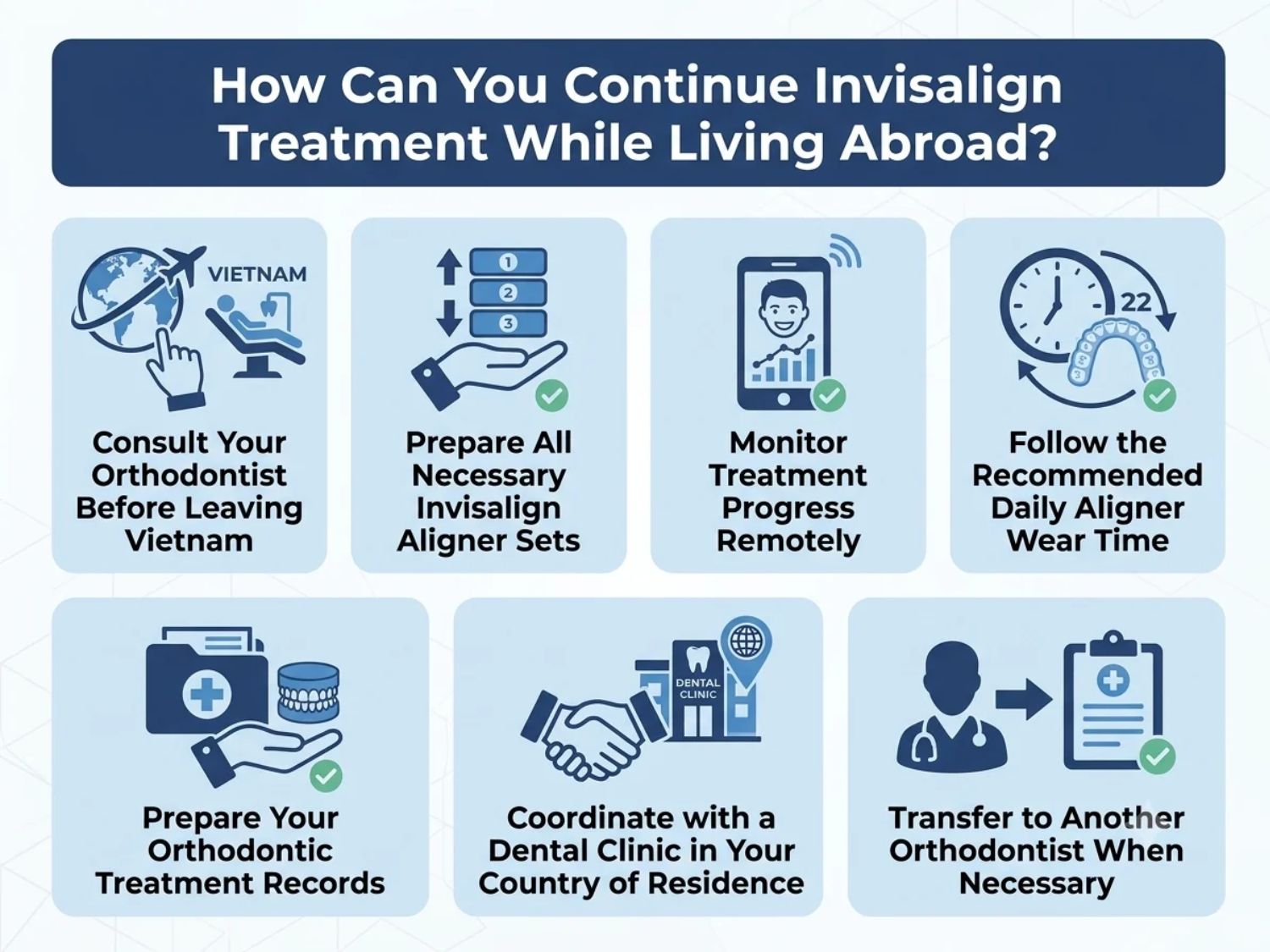
1. How Can You Continue Invisalign Treatment While Living Abroad?
Patients can continue Invisalign treatment while living abroad through online progress monitoring, wearing the aligner sets prescribed by their orthodontist, and attending in-person appointments at a dental clinic in their country of residence when necessary.
To continue Invisalign treatment while overseas, patients should take the following steps:
- Consult Your Orthodontist Before Leaving Vietnam: Inform your orthodontist about how long you plan to stay abroad so they can assess your tooth movement progress, bite alignment, and determine how many aligner sets you can safely use during your absence.
- Prepare All Necessary Invisalign Aligner Sets: Collect the next sets of aligners according to your treatment plan, check their sequence numbers, and carefully follow the instructions for changing aligners. Do not switch to a new aligner on your own if the current one does not fit snugly against your teeth or if there are signs that tooth movement is not progressing according to plan.
- Monitor Treatment Progress Remotely: Submit photographs of your teeth periodically or use an online monitoring system if your dental clinic provides one. Your orthodontist may conduct a preliminary assessment of how well the aligners fit, the condition of the attachments, and any visible changes in tooth positioning.
- Follow the Recommended Daily Aligner Wear Time: Invisalign aligners generally need to be worn for approximately 20–22 hours per day, unless your orthodontist provides different instructions. Insufficient wear time may cause teeth to move more slowly or prevent them from fitting properly into the next aligner set.
- Prepare Your Orthodontic Treatment Records: Keep copies of your dental X-rays, digital dental scans, ClinCheck treatment plan, information about your current aligner sets, and treatment history. These documents will make it easier to communicate with a dentist or orthodontist in another country.
- Coordinate with a Dental Clinic in Your Country of Residence: If an attachment becomes detached, an aligner no longer fits properly, prolonged pain occurs, or interproximal reduction (IPR) is required, you will need an in-person dental examination. These procedures cannot be replaced by online consultations.
- Transfer to Another Orthodontist When Necessary: If you plan to settle abroad for an extended period, you may discuss transferring your Invisalign treatment records to another orthodontist who uses the Invisalign system. Transferring a case requires coordination between the parties involved and may result in additional costs or the need to develop a revised treatment plan.
Invisalign offers a Virtual Care AI tool that helps orthodontists monitor treatment progress between appointments using photographs submitted by patients through the My Invisalign application. This tool can help identify signs that aligners are not tracking properly, allowing the orthodontist to review the situation and provide appropriate guidance.
Source: Invisalign – Virtual Care AI.
2. Can Other Clear Aligner Brands Be Monitored Remotely?
Patients using clear aligners from brands other than Invisalign may still receive remote monitoring if their dental clinic has an appropriate treatment management system and their orthodontist directly supervises the process. However, the feasibility of remote monitoring depends on the aligner brand, supporting software, stage of orthodontic treatment, and the patient’s actual tooth movement progress.
Important factors that determine whether clear aligner treatment can be monitored remotely include:
- Clear Aligner Brand and System: Some systems, such as ClearCorrect, Spark, and other clear aligner brands, may allow orthodontists to monitor treatment through clinical records, photographs, and suitable supporting tools. However, not every brand provides its own dedicated remote monitoring application.
- Treatment Management Software: If the dental clinic uses a remote monitoring system or a compatible online platform, the orthodontist can receive photographs periodically, conduct a preliminary assessment of aligner fit, and identify signs that tooth movement is not progressing according to plan.
- Dental Condition and Treatment Complexity: Cases involving stable tooth movement, properly fitting aligners, and no need for additional procedures may be suitable for a combination of remote monitoring and scheduled in-person appointments. More complex orthodontic cases generally require more frequent direct examinations.
- Availability of Treatment Records: Patients should have access to their digital dental scans, planned tooth movement data, current aligner sequence numbers, and treatment history to help the orthodontist assess treatment progress more accurately.
- Coordination with an Orthodontist Abroad: When attachments need to be reattached, interproximal reduction (IPR) is required, aligners do not fit properly, or treatment adjustments are necessary, patients must undergo an in-person examination at an appropriate dental facility.
- Ability to Transfer Treatment: If a patient changes dental clinics or moves to another country, the ability to continue using the existing aligner system depends on whether the new orthodontist agrees to accept the case, has access to the necessary treatment software, and can obtain the relevant treatment records. In some cases, a new dental scan and a revised treatment plan may be required.
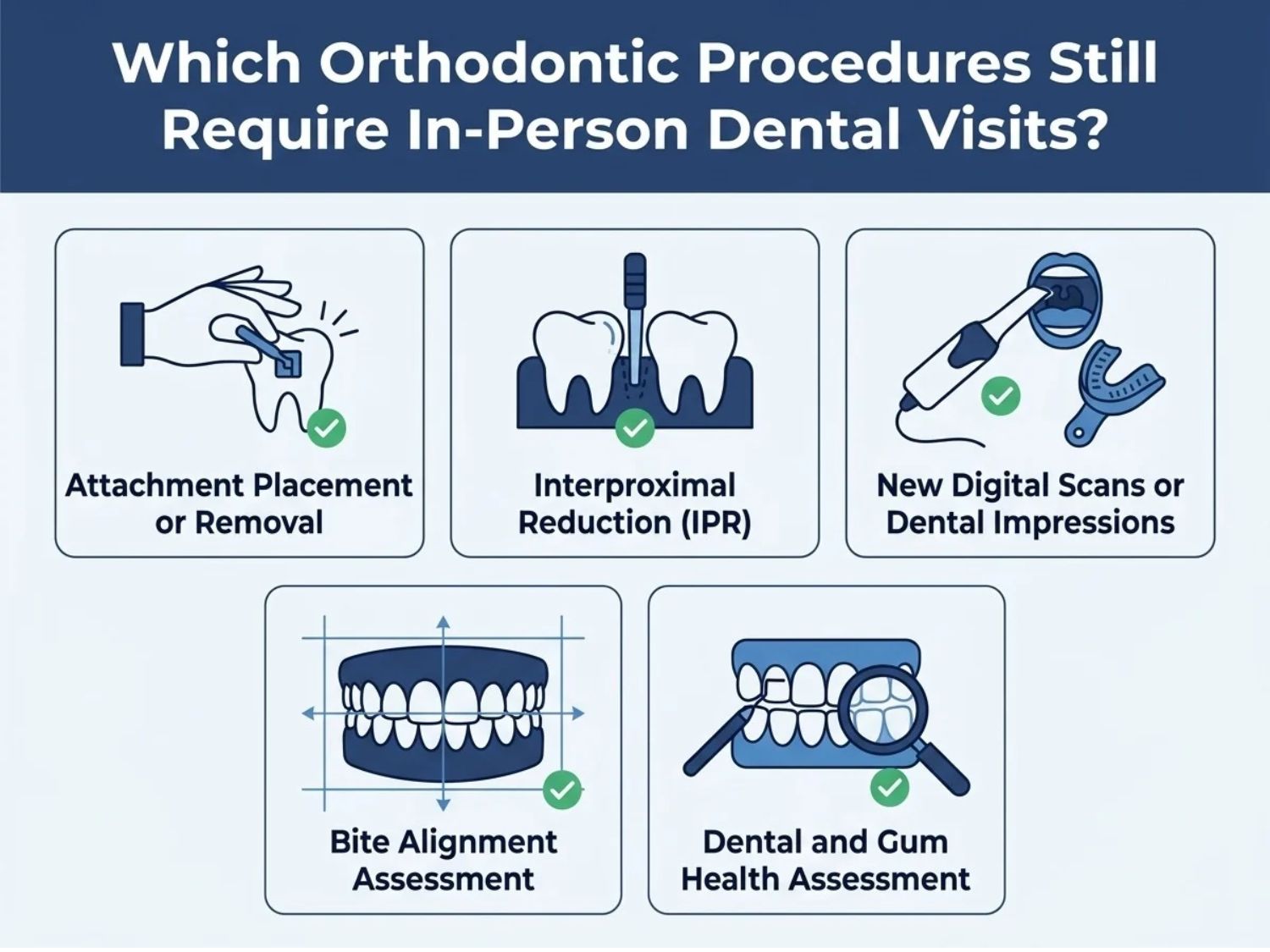
3. Which Orthodontic Procedures Still Require In-Person Dental Visits?
Remote monitoring through dental photographs can help orthodontists assess treatment progress, but it cannot replace procedures that require a dentist to examine the teeth and perform clinical work directly inside the mouth.
Some procedures that may be necessary during orthodontic treatment include:
- Attachment Placement or Removal: Attachments are small composite resin shapes bonded to the surfaces of teeth to help aligners apply the forces needed for tooth movement. Placing, adjusting, or removing these attachments must be performed at a dental clinic.
- Interproximal Reduction (IPR): If the treatment plan requires creating additional space between teeth, the orthodontist must determine the appropriate locations and amount of enamel reduction before performing the procedure directly.
- New Digital Scans or Dental Impressions: When refinement aligners are required, the orthodontist may request new intraoral scans or dental impressions to update the treatment plan based on the teeth’s current positions.
- Bite Alignment Assessment: The orthodontist needs to evaluate how the upper and lower teeth come into contact, the extent of tooth movement, and any changes that could affect chewing function.
- Dental and Gum Health Assessment: Conditions such as gingivitis, tooth decay, loose teeth, or unusual dental pain require an in-person examination.
4. What Should You Prepare Before Moving or Traveling Abroad?
Patients should agree on a remote monitoring plan with their orthodontist, prepare their treatment records, and establish contingency plans for unexpected situations before leaving Vietnam.
The necessary preparation steps include:
- Inform Your Orthodontist About Your Travel Plans: Provide details about your destination country, expected length of stay, flight schedule, and ability to return to Vietnam. This information helps the orthodontist determine an appropriate treatment schedule.
- Check Your Dental Condition Before Departure: Have the orthodontist assess aligner fit, tooth movement progress, attachments, and any remaining procedures that may need to be completed.
- Obtain Your Orthodontic Records: Request copies of your 3D treatment plan, ClinCheck records if available, dental X-rays, intraoral photographs, digital dental scans, and treatment history.
- Confirm Your Aligner Replacement Schedule: Clearly document the aligner sequence numbers, how long each aligner should be worn, and when photographs should be submitted for professional review.
- Prepare for Lost or Damaged Aligners: Ask your orthodontist what to do if an aligner is lost or damaged while you are overseas. Do not independently switch to another aligner without professional instructions.
- Save Important Contact Information: Keep the dental clinic’s telephone number, email address, or online communication channels so you can contact the treatment team whenever necessary.
- Arrange Follow-Up Appointments: Identify the stages of treatment that require an in-person examination and establish a plan for finding an orthodontist in your country of residence if returning to Vietnam is not possible.
5. What Should You Do If an Aligner Is Lost, Damaged, or Your Teeth Are Not Moving as Planned?
Do not independently skip an aligner, switch to the next aligner, or return to a previous aligner without instructions from your orthodontist.
Several situations may occur while patients are living or traveling abroad:
- Lost Aligner: Contact your orthodontist and provide the sequence number of the aligner you were wearing and how long you had been using it. The orthodontist will assess whether you should use the previous aligner, obtain a replacement, or adjust your treatment schedule.
- Cracked or Deformed Aligner: Send photographs of the damaged aligner to your orthodontist and ask for appropriate instructions. Do not continue wearing a damaged aligner if it may injure the soft tissues or can no longer apply orthodontic forces correctly.
- Aligner Does Not Fit Properly: Do not force an aligner into position if it does not fit correctly, causes pain, or leaves unusual gaps between the aligner and the teeth. Submit photographs so your orthodontist can assess the situation.
- Persistent Pain or Unusually Loose Teeth: Arrange an in-person dental examination, particularly if the symptoms worsen or interfere with chewing.
- Unable to Contact Your Orthodontist in Vietnam: You may seek assistance from an orthodontist in your current country of residence for an examination and provide the treatment records you prepared before traveling.
6. Frequently Asked Questions About Remote Orthodontic Treatment Started in Vietnam
Can I Start Invisalign Treatment in Vietnam and Continue It After Moving to the United States?
Yes. You may be able to continue remote monitoring with your orthodontist in Vietnam or transfer your treatment records to an orthodontist in the United States.
The most appropriate arrangement depends on your current treatment progress, whether the new orthodontist agrees to accept your case and records, and the treatment and follow-up plan established by the new provider.
Are Photographs of My Teeth Sufficient for My Orthodontist to Monitor Treatment Progress?
Dental photographs can help the orthodontist assess certain visible signs, such as how well the aligners fit and whether tooth movement appears to be progressing according to the treatment plan.
However, photographs cannot fully replace in-person examinations, dental X-rays, or bite assessments when these are clinically necessary.
Will I Have to Restart Orthodontic Treatment From the Beginning If I Transfer to an Orthodontist Abroad?
Not necessarily. The new orthodontist will need to examine your teeth, review your orthodontic records, and evaluate your current treatment plan before deciding whether the existing plan can be continued or needs to be adjusted.
Depending on your dental condition and treatment progress, it may be possible to continue the current treatment without starting the entire orthodontic process again.
Dental Clinic OptionsDental Veneers in Ho Chi Minh City and Hanoi: Costs, Quality, and Dental Clinic Options
Dental Implants in Vietnam for Foreigners: Costs, Implant Brands, and Warranty Policies