
Date posted: 13-11-2026 | Last updated : 18-11-2026
A mini facelift is suitable for individuals aged approximately 35–45 who show mild to moderate signs of aging, primarily affecting the lower cheeks and jawline. Meanwhile, a full facelift is considered when soft tissue sagging affects multiple areas, including the mid-cheeks, lower cheeks, jawline, and neck.
A mini facelift focuses on improving the lower cheeks and jawline, making it suitable for localized signs of aging.
A full facelift involves a more extensive surgical approach and may be combined with neck rejuvenation.
Individuals aged 35–45 are often considered for a mini facelift if skin laxity is still mild to moderate.
People over 50 may require a full facelift when significant excess skin, sagging cheeks, and neck laxity are present.
The choice should not be based on age alone. The location of tissue sagging, skin elasticity, neck condition, and overall health are more important factors.
A mini facelift and a full facelift differ primarily in their surgical scope, the areas of tissue being lifted, and the extent of intervention.
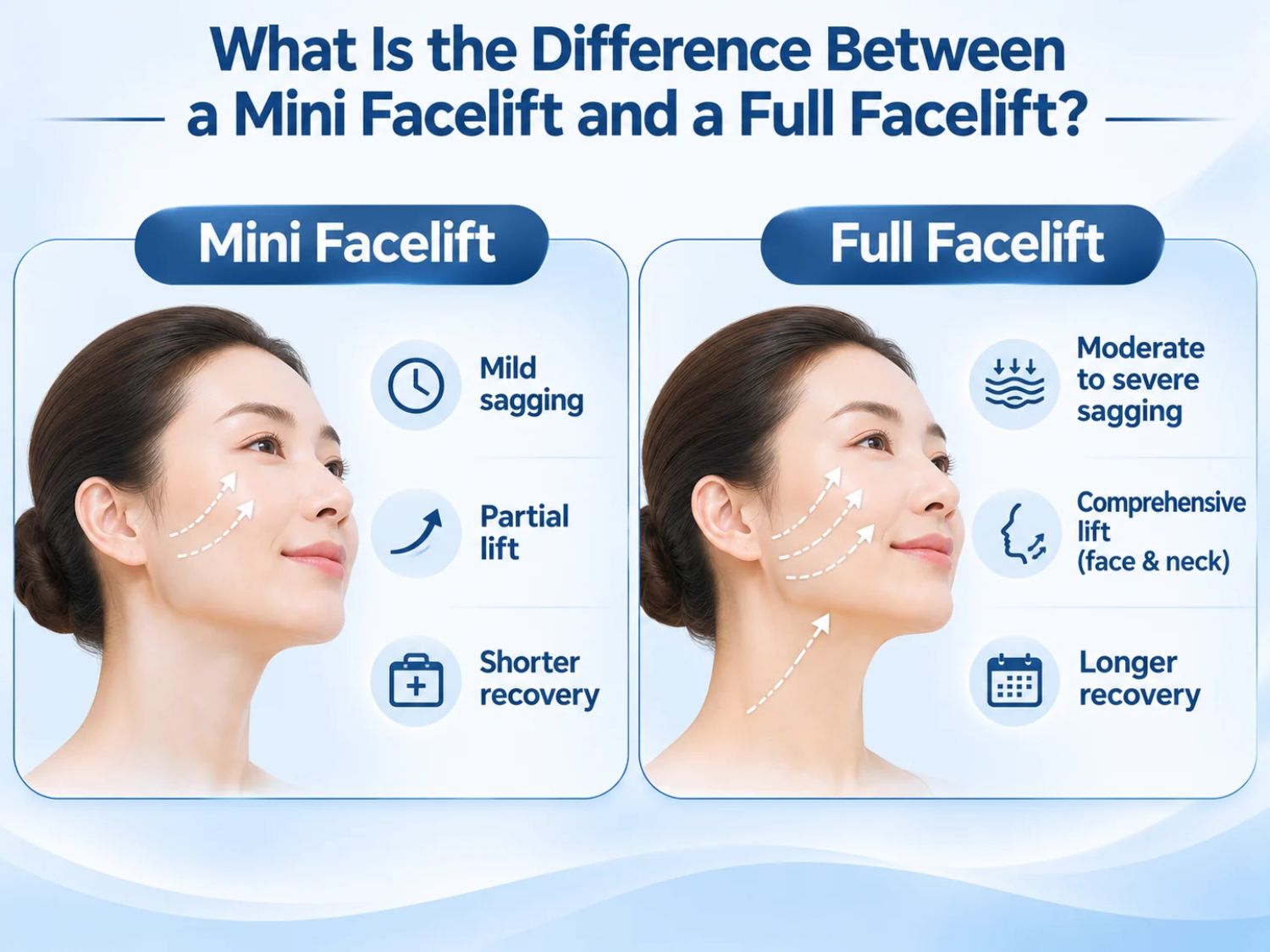
A mini facelift is generally considered for individuals aged approximately 35–50, when signs of aging begin to appear around the lower cheeks and jawline, while the skin still retains relatively good elasticity.
Common signs include:

A full facelift is generally considered for individuals over 50 or those who experience premature aging accompanied by soft tissue sagging in multiple facial areas. This procedure is more suitable when skin laxity is no longer limited to the lower cheeks but has extended to the mid-cheeks, jawline, and neck.
Common signs include:
A mini facelift involves a more limited surgical scope, so the incisions are generally shorter and recovery time is usually shorter. In contrast, a full facelift can improve multiple areas of facial aging simultaneously, but the extent of intervention and recovery process are generally more complex.
| Criteria | Mini Facelift | Full Facelift |
|---|---|---|
| Areas addressed | Primarily lower cheeks and jawline | Mid-cheeks, lower cheeks, jawline, and potentially the neck |
| Degree of aging | Mild to moderate, localized | Moderate to advanced, affecting multiple areas |
| Incisions | Generally shorter, around the ears | Generally more extensive, potentially extending behind the ears and along the hairline |
| Extent of intervention | More limited | More extensive |
| Neck treatment | Limited unless combined with a separate technique | Can be combined with a neck lift |
| Scarring | Generally involves shorter incisions | Generally involves longer incisions |
| Recovery | Usually faster | Usually requires more recovery time |
| Results | Rejuvenation focused on the treated areas | Addresses a wider range of aging concerns |
According to the International Society of Aesthetic Plastic Surgery (ISAPS), swelling and bruising after a mini facelift generally decrease significantly within approximately two weeks. Many individuals can return to work and light daily activities after 7–14 days. Recovery after a full facelift may take longer, depending on the extent of tissue dissection and any additional procedures performed. These are general reference timelines and do not apply to every individual.
Source: https://www.isaps.org/discover/patients-home/procedures/face-head-procedures/mini-facelift/
A 58-year-old may still be suitable for a mini facelift if signs of aging are primarily concentrated around the lower cheeks and jawline, while the neck skin remains firm and there is no significant excess skin.
For example, a 58-year-old individual may present with the following characteristics:
A 45-year-old may still be considered for a full facelift if signs of aging have spread across multiple areas of the face and neck.
Possible contributing factors include:

Before deciding between a mini facelift and a full facelift, the surgeon needs to evaluate facial structure, the degree of soft tissue descent, skin elasticity, neck condition, and overall health. These assessments provide the basis for determining the appropriate surgical scope rather than making a decision based solely on age or personal preference.
The evaluation should include:

A mini facelift does not maintain its results as long as a full facelift. A mini facelift typically lasts approximately 5–7 years, while a full facelift may maintain its results for approximately 10–15 years, depending on the surgical technique, degree of aging, and each individual’s characteristics.
A mini facelift can improve a double chin, but the effectiveness depends on its underlying cause. This procedure is more suitable when the double chin results from mild sagging of the skin and soft tissues around the lower jaw. If the fullness is primarily caused by fat accumulation beneath the chin, loose neck muscles, or significant excess neck skin, a mini facelift alone generally cannot address the issue completely.
Yes. A full facelift generally leaves longer incisions than a mini facelift because it involves a wider surgical area. However, this does not necessarily mean that the scars will be large, thick, or more noticeable. When performed using appropriate surgical techniques, the scars are generally concealed along the hairline, natural creases in front of the ears, and the folds behind the ears, making them relatively difficult to notice once fully healed.
Private: How Much Does a Facelift Cost in Vietnam? SMAS vs. Deep Plane Comparison