Date posted: 13-11-2026 | Last updated : 18-11-2026
The cost of a facelift in Vietnam ranges from approximately USD 753 to USD 3,744, depending on the procedure, treatment area, and combination of services. A 3D facelift costs around USD 2,702, while a combined facelift and neck lift costs approximately USD 3,744.
Facelift-related services in Vietnam are priced at approximately USD 753–3,744.
A 3D facelift costs around USD 2,702.
A combined facelift and neck lift costs approximately USD 3,744.
The SMAS technique is commonly considered when sagging is concentrated in the lower face and along the jawline.
The Deep Plane technique may be suitable for more pronounced sagging in the midface, nasolabial folds, and lower face.
No single technique is suitable for every patient. A surgeon must assess facial anatomy and the degree of aging before recommending a procedure.
The cost of facelift-related procedures in Vietnam ranges from approximately USD 753 to USD 3,744, depending on the type of service and the extent of facial rejuvenation.
The following table provides reference prices for facial rejuvenation and facelift procedures:
| Service | Estimated Cost (USD) |
|---|---|
| 3D Facelift | USD 2,702 |
| Combined Facelift and Neck Lift | USD 3,744 |
| Mi Young Thread Lift | USD 1,177–1,621 |
| Mi Young Rejuvenation | USD 1,177–3,474 |
| X-line Thread Lift | USD 753–3,474 |
Note: An additional 10% is charged for minor surgery, while major surgery incurs an additional 5%, according to the provided fee schedule.
Both SMAS and Deep Plane are facelift techniques designed to improve facial sagging. However, they differ in the surgical plane and the way supporting structures are treated. The SMAS technique focuses on the superficial musculoaponeurotic system, while the Deep Plane technique involves deeper dissection beneath the SMAS layer to release the ligaments that support facial tissues.
SMAS (Superficial Musculoaponeurotic System) is a layer of connective tissue and muscle located beneath the subcutaneous fat. It connects and supports the soft tissues of the face.
During SMAS facelift surgery, the surgeon separates the skin and works on the SMAS layer using techniques such as plication, suspension, or excision and repositioning of the SMAS, depending on the patient’s condition. After repositioning and supporting the underlying tissues, excess skin is adjusted and the incisions are closed.
This technique is commonly used to improve:
There are several variations of the SMAS technique. Therefore, the results depend on the dissection method, how the SMAS layer is treated, and the surgeon’s experience.
A Deep Plane facelift is performed in a deeper surgical plane beneath the SMAS layer. Rather than simply tightening the skin or separately lifting the SMAS layer with sutures, the surgeon releases the facial retaining ligaments and then repositions the soft tissue mass in an appropriate lifting direction.
This technique may improve:
Because the procedure involves working in a deep plane close to the branches of the facial nerve, Deep Plane surgery requires advanced anatomical knowledge, the ability to identify relevant structures, and precise control of tissue dissection.

SMAS is generally considered when aging is concentrated in the lower face, whereas Deep Plane may be suitable for cases involving pronounced midface tissue descent that requires the release of facial retaining ligaments.
| Criteria | SMAS Facelift | Deep Plane Facelift |
|---|---|---|
| Surgical plane | Superficial musculoaponeurotic system (SMAS) | Deep plane beneath the SMAS |
| Lifting mechanism | SMAS plication, suspension, or excision and repositioning | Release of retaining ligaments and lifting of the soft tissue mass |
| Areas improved | Lower cheeks, jawline, and lower face | Midcheeks, nasolabial folds, and jawline |
| Tissue impact | Treats the SMAS layer and skin in separate layers | Mobilizes and repositions the connected soft tissue mass |
| Natural appearance | Depends on the lifting direction and tension applied | May allow more coordinated repositioning of facial tissues |
| Complexity | Varies depending on the SMAS technique used | Requires detailed anatomical knowledge and advanced deep-plane dissection skills |
| Recovery | Depends on the extent of surgery | Depends on the extent of surgery and degree of dissection |
| Longevity | Depends on the technique, individual characteristics, and aging process | Depends on the technique, individual characteristics, and aging process |
A systematic review and meta-analysis published in Aesthetic Plastic Surgery in 2025 evaluated 21 studies involving 2,896 patients. The reported satisfaction rate was 94.4% for the Deep Plane group, compared with 87.8% for the SMAS group. However, the pooled complication rates were 17.2% and 10.3%, respectively. Because the included studies differed in assessment methods and patient characteristics, these findings are insufficient to establish that Deep Plane is superior to SMAS in every case. The choice of technique should still be individualized according to the patient’s aging pattern and surgical indications.
The Deep Plane versus SMAS Facelift: A Systematic Review and Meta-Analysis – PubMed (2025).
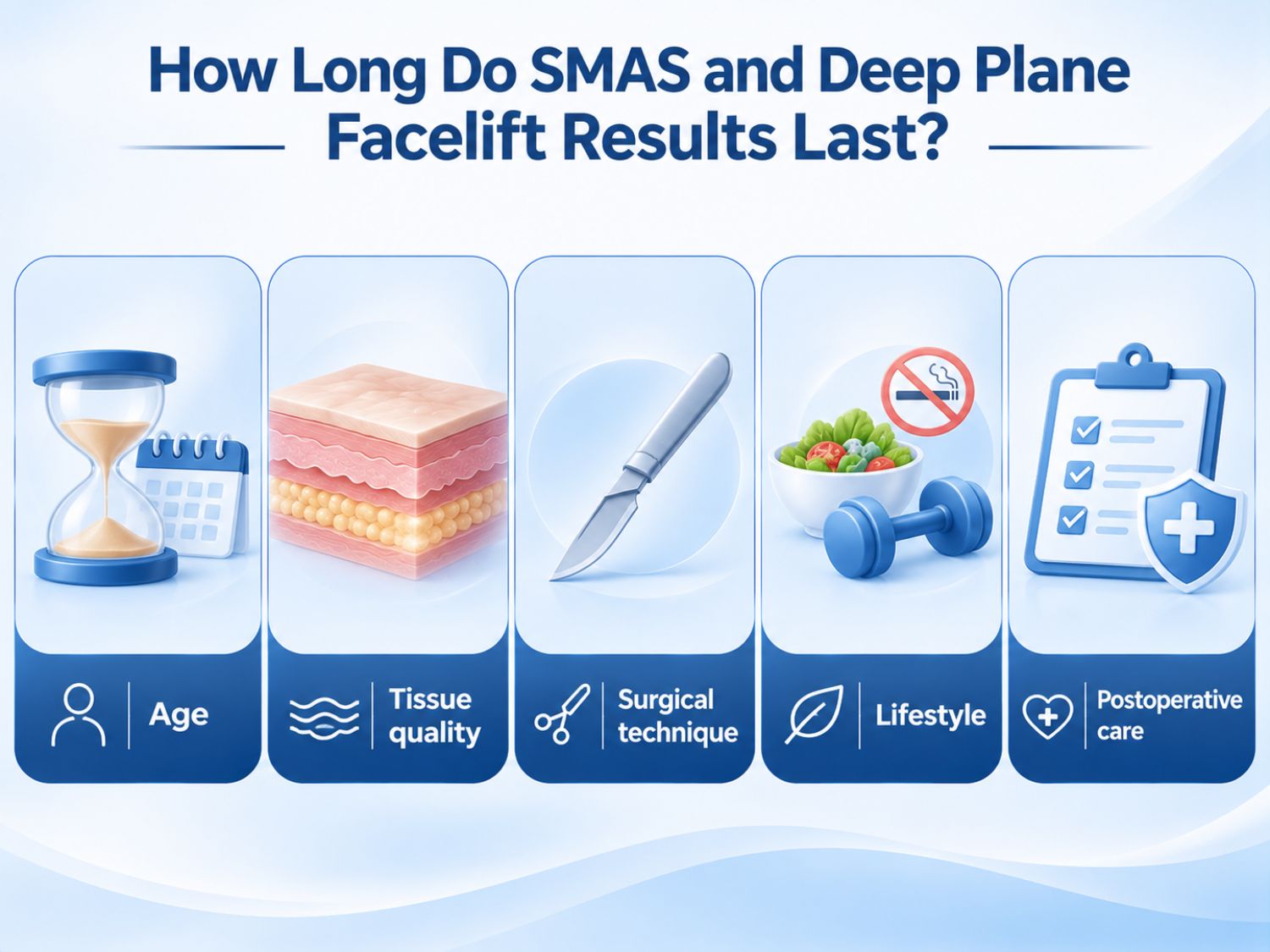
SMAS facelift results generally last around 7–10 years, while Deep Plane facelift results may last approximately 10–15 years or longer, depending on individual characteristics and surgical technique. Deep Plane may maintain its results for longer in some cases because it releases the facial retaining ligaments and lifts deeper tissue layers, rather than primarily treating the SMAS layer.
Several factors influence how long the results last:
The facelift process includes consultation, tissue assessment, preoperative health checks, technique selection, surgery, and postoperative monitoring. The procedure duration and recovery period depend on the extent of surgery and each patient’s condition.
Step 1: Consultation and Aging Assessment
The surgeon examines skin laxity, the location of sagging soft tissues, nasolabial folds, jawline definition, and the neck. The surgeon also assesses the patient’s facial anatomy to determine whether the SMAS layer needs to be treated or whether ligament release using the Deep Plane technique is appropriate.
Step 2: Preoperative Health Assessment
Patients undergo a general health assessment, laboratory tests, and an evaluation of anesthesia-related risks. Medical conditions such as cardiovascular disease, high blood pressure, blood clotting disorders, the use of anticoagulant medication, and previous surgical history should be fully disclosed.
Step 3: Surgical Planning
The surgeon determines the areas requiring lifting, the tissue treatment method, incision locations, and the extent of excess skin removal. If signs of neck aging are also present, the patient may be advised to combine the facelift with a neck rejuvenation procedure during the same operation, provided they meet the necessary medical requirements.
Step 4: Surgery
The operation is performed in an operating room that meets professional medical standards. The surgeon carries out tissue dissection, lifting, and repositioning according to the surgical plan, followed by excess skin removal and incision closure.
Step 5: Postoperative Monitoring and Care
After surgery, patients are monitored for bleeding, swelling, pain, and any unusual signs. Instructions are provided regarding dressing changes, suture removal, and follow-up appointments based on the patient’s recovery.

When choosing a facelift provider, patients should prioritize a licensed medical facility, a suitably qualified surgeon, an adequate anesthesia and resuscitation system, and the ability to manage complications. Decisions should not be based solely on low prices or advertising claims about Deep Plane or SMAS techniques.
Important criteria to check include:
Vietnamese expatriates and international patients should also account for airfare, accommodation, and the amount of time they need to stay in Vietnam for postoperative monitoring. Patients should not schedule a long-haul flight immediately after surgery unless they have been assessed and cleared by their surgeon.

People over 50 may be suitable candidates for either SMAS or Deep Plane facelifts. However, Deep Plane is often considered when signs of aging are more pronounced, particularly sagging cheeks, deep nasolabial folds, excess skin, and loss of jawline definition. Conversely, when sagging is mild to moderate and the supporting tissue structure remains relatively good, a SMAS facelift may still provide an appropriate result.
Yes. A surgeon may combine a facelift and neck lift in the same operation if the patient has appropriate surgical indications and is medically fit for the procedures. The cost depends on the extent of intervention.
No. Surgery primarily improves sagging skin and soft tissues, jawline definition, and signs of aging caused by tissue descent. Fine wrinkles related to skin quality, sun damage, or facial muscle activity may remain and may require other treatment or skincare methods.
Mini Facelift vs. Full Facelift: Which Procedure Should You Choose Based on Your Age?