Date posted: 21-07-2026 | Last updated : 25-07-2026
Before deciding to improve their body contours through liposuction, many people wonder: “Is abdominal liposuction painful?”
This concern is completely understandable. With modern liposuction technology, medically supervised anaesthesia, and appropriate postoperative care, discomfort can generally be controlled effectively.
Patients generally do not feel pain during abdominal liposuction because the procedure is performed under anaesthesia.
Depending on the treatment extent and the patient’s health, the medical team may use:
After the anaesthetic wears off, patients may experience:
These are common postoperative reactions.
The level of discomfort depends on:
To control discomfort and support recovery, the doctor may prescribe suitable pain medication and provide detailed wound-care and activity instructions.

Patients receive anaesthesia before abdominal liposuction, helping control pain during the procedure.
However, abdominal liposuction should not be described as completely painless. Anaesthesia controls pain during surgery, but soreness and tightness are expected during the early recovery period.
Patients can learn more about the procedure in Abdominal Liposuction in Vietnam for International Patients.
Several factors influence the degree of pain and discomfort after abdominal liposuction, including the technology used, the surgeon’s expertise, the treatment area, the amount of fat removed, and the patient’s individual response.
Modern technologies such as Vaser-assisted liposuction use ultrasound energy to loosen fat before removal.
This may help the surgeon remove fat more smoothly and reduce the force required during the procedure.
Compared with some traditional techniques, controlled fat loosening may help limit:
However, no device can guarantee that there will be no pain or swelling after surgery.

Modern liposuction technology may help reduce unnecessary tissue trauma and postoperative discomfort.
Further information about the technology is available in Kangnam’s Lipo 360 Body-Contouring Technology.
An experienced surgeon performs the procedure with controlled movements and aims to avoid unnecessary damage to:
Accurate technique may reduce swelling, bruising, pain, and contour irregularities.
Patients should verify the surgeon’s medical licence, qualifications, and experience with abdominal liposuction before treatment.
Larger treatment areas and higher volumes of fat removal generally produce more swelling, inflammation, and postoperative soreness.
Patients undergoing treatment of the:
at the same time may require a longer recovery period than those receiving treatment in one small area.
The amount of fat removed should be based on safety and body proportions rather than the patient’s desire for the largest possible reduction.
Each patient has a different pain threshold and recovery rate.
People with sensitive tissues or a lower pain tolerance may experience discomfort for longer.
Other factors that may affect recovery include:
To manage discomfort and support recovery, patients should use prescribed medication correctly, care for the incisions, move gently, wear compression garments when recommended, and rest adequately.
The doctor may prescribe:
Patients should take medication exactly as prescribed.
They should not:
Proper incision care may reduce pain, irritation, and infection risk.
Patients should:
A compression garment may help:
The garment should fit firmly but should not cause:
Patients should follow the surgeon’s schedule rather than tightening or removing the garment without guidance.
Gentle walking is often encouraged after surgery because it supports circulation and reduces the risks associated with prolonged immobility.
Patients should avoid:
The timing for returning to exercise should be confirmed by the surgeon.
Patients should get sufficient sleep and avoid overexertion during the early recovery period.
Some patients may need hospital monitoring for approximately one to two days, depending on:

Patients should rest appropriately after abdominal liposuction.
More information about postoperative care and body-contouring surgery is available in What Is Liposuction?.
At Kangnam Aesthetic Hospital, the abdominal liposuction process is designed to control discomfort and support recovery through anaesthesia, modern fat-removal technology, medical monitoring, and postoperative care.
Kangnam performs liposuction in a medically controlled environment using infection-control procedures and surgical monitoring equipment.
The hospital states that its process follows Vietnamese Ministry of Health requirements.
However, no facility can guarantee absolute sterility or completely eliminate the risks of infection, bleeding, or other complications.
Kangnam applies Vaser-assisted technology to selected abdominal liposuction procedures.
The ultrasound energy helps loosen the fat before suction, which may allow the surgeon to remove it with less force.
This may help reduce:
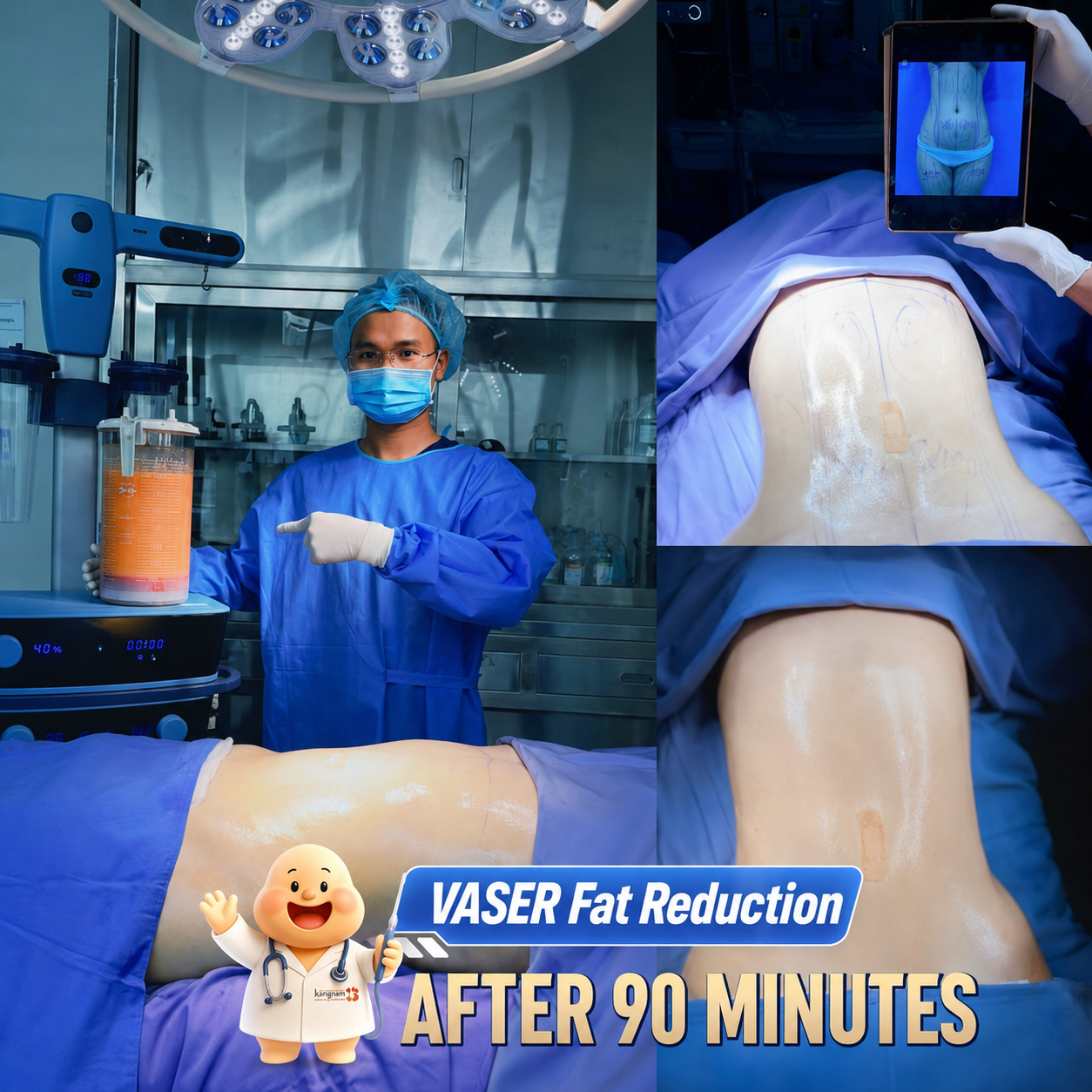
Vaser-assisted technology is used to support controlled abdominal fat removal.
The technology itself does not guarantee a pain-free procedure or recovery. Results depend on the surgeon’s technique, patient selection, treatment extent, and postoperative care.
Anaesthesia is administered and monitored by qualified medical personnel.
The anaesthesia team evaluates:
The patient’s vital signs are monitored throughout the operation.
Although anaesthesia prevents pain during surgery, it carries its own risks and must be administered under appropriate medical supervision.
After surgery, the patient may receive an individual pain-management plan combining:
The purpose is to keep discomfort manageable while allowing the patient to move safely and recover.
Kangnam provides postoperative care designed to manage discomfort and support recovery.
Kangnam provides services designed for overseas Vietnamese patients with limited time in Vietnam.
These may include:
Patients should confirm these services and any related costs in writing before surgery.
Even with a streamlined process, overseas patients should remain in Vietnam long enough for:
International patients may review Liposuction in Ho Chi Minh City for International Patients when planning their treatment schedule.
Abdominal liposuction is generally not painful during the operation because anaesthesia is used. After surgery, patients may experience soreness, tightness, swelling, bruising, and mild to moderate pain.
Modern technology, an experienced surgeon, appropriate anaesthesia, and structured postoperative care can help control discomfort, but they cannot guarantee a completely painless or risk-free experience.
Patients should choose a licensed medical facility, verify the surgeon’s qualifications, and follow all postoperative instructions to support a safe recovery and achieve a slimmer abdominal contour.
Abdominal Liposuction in Vietnam for International Patients
What Is Liposuction? Procedure, Cost, and Safety Considerations