Date posted: 16-11-2026 | Last updated : 17-11-2026
Kangnam Aesthetic Hospital offers breast augmentation options involving Mentor, Motiva. Mentor MemoryGel and selected Motiva SmoothSilk models have received U.S. FDA approval. The safest approach is to verify the exact implant model, its regulatory documentation, and its suitability for your breast anatomy before surgery.
Mentor: MemoryGel and MemoryGel Xtra are part of an FDA-approved implant family, with options designed for different breast shapes and projection needs.
Motiva: SmoothSilk Round and SmoothSilk Round Ergonomix received FDA approval in September 2024; approval does not automatically extend to every Motiva model.
Safety: Regulatory approval is important, but surgeon expertise, implant sizing, surgical technique, and follow-up care also influence outcomes.
Kangnam’s published breast augmentation information identifies Mentor and Motiva as major implant brands. These brands offer different silicone gel characteristics, surface technologies, and breast-shaping options.
Based on Kangnam’s published procedure descriptions and treatment information, the relevant implant options include:

For Jessica, the first question should therefore be which specific manufacturer and implant model the surgeon recommends, rather than simply whether Kangnam works with an internationally recognized brand.
A brand may manufacture several implant generations, and their approvals, features, and clinical evidence can differ.
Mentor and certain Motiva breast implant models have confirmed FDA approval, while PERLE does not appear on the FDA’s approved breast implant list. It is important to compare the exact product rather than assuming that approval applies to all implants sold under one brand.
| Implant brand or model | Manufacturer | U.S. FDA approval status | Main consideration |
| Mentor MemoryGel | Mentor / Johnson & Johnson | FDA-approved | Silicone gel implants with different sizes and profiles |
| Mentor MemoryGel Xtra | Mentor / Johnson & Johnson | FDA-approved under the MemoryGel device family | Designed to provide greater fullness and projection in selected profiles |
| Motiva SmoothSilk Round | Motiva / Establishment Labs | FDA-approved in 2024 | Round implant with controlled smooth-surface technology |
| Motiva SmoothSilk Round Ergonomix | Motiva / Establishment Labs | FDA-approved in 2024 | Designed to provide a more adaptable breast contour |
| Motiva Nano Chip / other Ergonomix versions | Motiva / Establishment Labs | Verify exact model and approved configuration | Product identification features and model specifications vary |
Mentor breast implants are known for their established silicone gel implant families, including MemoryGel and MemoryGel Xtra, which offer different degrees of breast projection and fullness.
Two options commonly discussed for augmentation are:

Advantages: Mentor offers an established implant family with FDA-reviewed clinical information, multiple size options, and different projection choices.
Limitations: A fuller or firmer implant is not automatically more natural-looking. In patients with limited tissue coverage, excessive implant projection may make the edges more visible or place additional tension on the tissues.
Mentor may be considered for patients who want clearly defined breast fullness, provided the selected implant fits their chest width and skin characteristics.
Motiva breast implants are designed with controlled surface technology and silicone gels intended to provide different breast contours and movement characteristics. The SmoothSilk Round and SmoothSilk Round Ergonomix models received U.S. FDA approval on September 26, 2024.
Motiva’s main features include:

Advantages: Motiva may appeal to patients seeking flexible breast contours and an implant designed to respond to body movement.
Limitations: The final appearance still depends on natural tissue coverage, implant placement, skin quality, and surgical technique. A flexible implant does not guarantee that the breast will look or feel identical to a natural breast.
FDA approval means a specific breast implant has undergone regulatory review and met the applicable requirements for its approved use; it does not mean the implant is risk-free or guaranteed to last a lifetime.
Every breast implant can be associated with complications, including:
The American Society of Plastic Surgeons (ASPS) explains that smooth and textured implants have different movement and tissue-interaction characteristics. Its guidance also emphasizes that implant-associated lymphoma has been reported most frequently with textured implants, making surface selection and informed consent important.
International medical source: American Society of Plastic Surgeons – Types of Breast Implants
The most reliable way to confirm implant authenticity is to match the implant packaging, model information, and serial or lot number with the manufacturer’s records and the patient’s surgical documentation.
Before breast augmentation, patients should request the following:
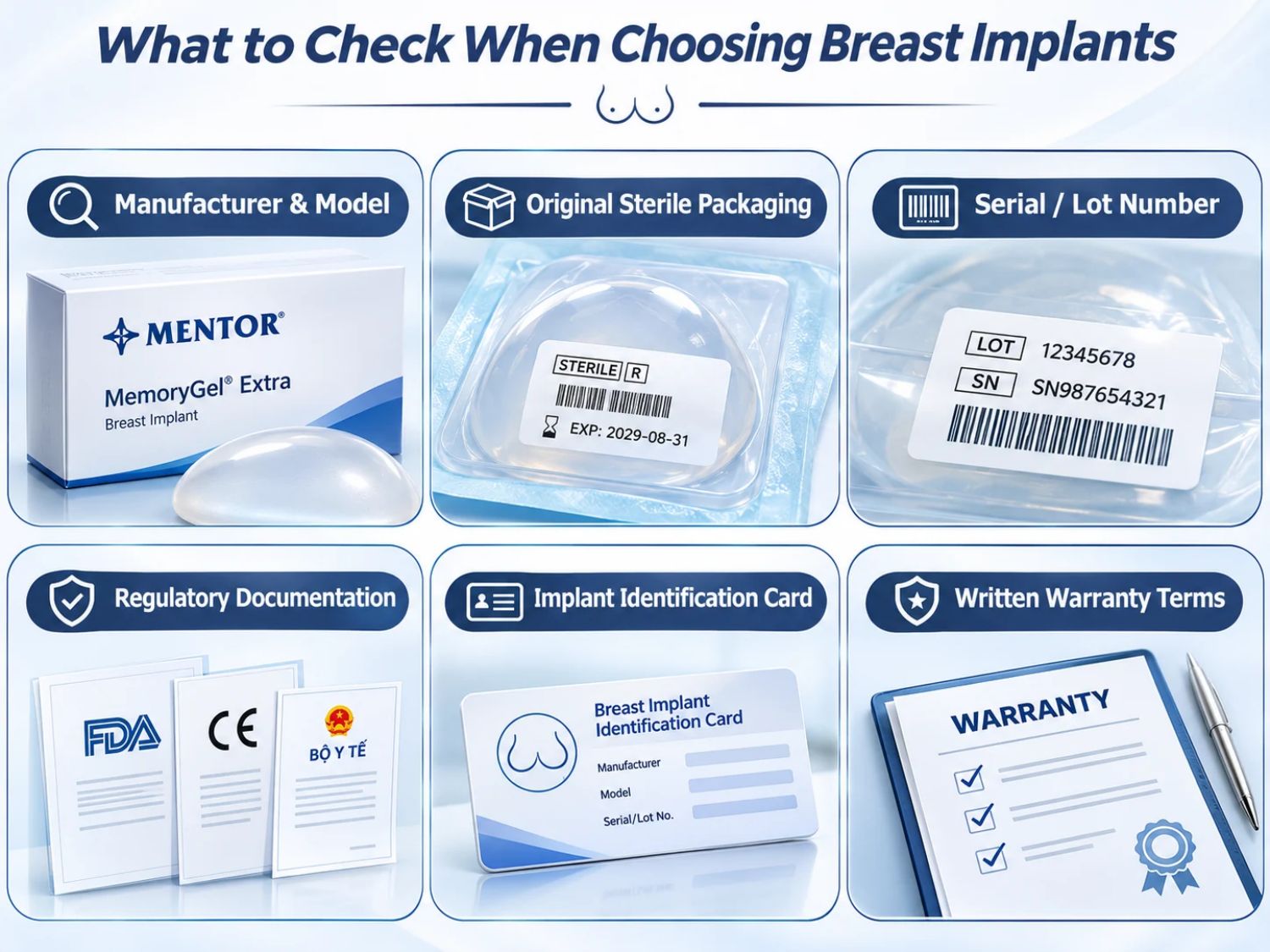
How Can Patients Verify Genuine Breast Implants at Kangnam
For implants containing an identification microtransponder, the chip may help confirm the product’s identifying information using an appropriate reader.
It is not a GPS tracking device and does not provide real-time information about the patient’s location or implant condition.
International patients should keep digital copies of their implant card and operative report because these documents may be necessary if they consult another surgeon after returning home.
Kangnam describes an individualized assessment process involving breast measurements, three-dimensional planning, surgical preparation, and postoperative follow-up. These steps help the surgical team evaluate whether the chosen implant size and placement suit the patient’s anatomy.
The selection process should consider:
For example, a slim patient with very little existing breast tissue may not be suitable for an excessively large implant, regardless of the brand. Additional tissue coverage, a different projection, or a smaller volume may provide a more balanced outcome.
FDA approval and European CE marking operate under different regulatory systems and should not be treated as identical certifications. Neither designation alone determines which breast implant will produce the best result for an individual patient.
Neither Mentor nor Motiva is universally better for every patient. Mentor offers different options for breast fullness and projection, while selected Motiva models emphasize adaptable gel and surface characteristics; the best choice depends on anatomical measurements and the desired outcome.
FDA-approved breast implants do not require automatic replacement at exactly 10 years, but they are not lifetime devices. Patients should undergo recommended monitoring, and replacement may become necessary because of rupture, capsular contracture, changes in appearance, or other complications.