Date posted: 16-11-2026 | Last updated : 18-11-2026
When comparing a breast lift vs breast augmentation, the right choice depends on whether your main concern is sagging, lost volume, or both. A breast lift raises and reshapes drooping breasts, while breast augmentation increases breast size and fullness using implants. Women with both significant sagging and volume loss may benefit from combining the two procedures, depending on their breast anatomy and desired results.
Breast lift: Best suited to sagging breasts with loose skin or low nipple position, particularly when existing breast volume is sufficient.
Breast augmentation: Best suited to small or deflated breasts that need additional fullness without significant lifting.
Combined surgery: Addresses both sagging and volume loss in appropriately selected patients.
The main difference is that a breast lift corrects breast position, while breast augmentation increases breast volume. Although both procedures improve breast appearance, they address different anatomical changes and cannot always replace one another.
| Comparison | Breast Lift (Mastopexy) | Breast Augmentation | Combined Lift + Augmentation |
| Main purpose | Lift and reshape sagging breasts | Increase breast size and fullness | Restore breast position and volume |
| Breast size | Usually remains similar | Increases | Increases according to implant selection |
| Nipple position | Can reposition low nipples | Usually does not significantly reposition nipples | Corrects low nipple position when a lift is included |
| Excess skin | Removes and tightens loose skin | Does not remove excess skin | Removes loose skin while adding volume |
| Upper-breast fullness | Limited improvement without added volume | Increases fullness | Improves fullness and breast position |
| Implant required | No | Yes, for implant-based augmentation | Yes |
| Scarring | Around areola, vertical, or anchor-shaped depending on technique | Often a shorter incision | Includes lift scars and implant-related incisions |
| Most suitable for | Sagging breasts with adequate volume | Small or deflated breasts without significant sagging | Sagging breasts with volume loss |
Nipple position relative to the natural breast crease is one of the most useful indicators of breast sagging. When nipples sit below the breast fold or point downward, a breast lift is more likely to be necessary.
The inframammary fold is the natural crease underneath each breast where the breast meets the chest wall.
A surgeon evaluates nipple position using the following general observations:
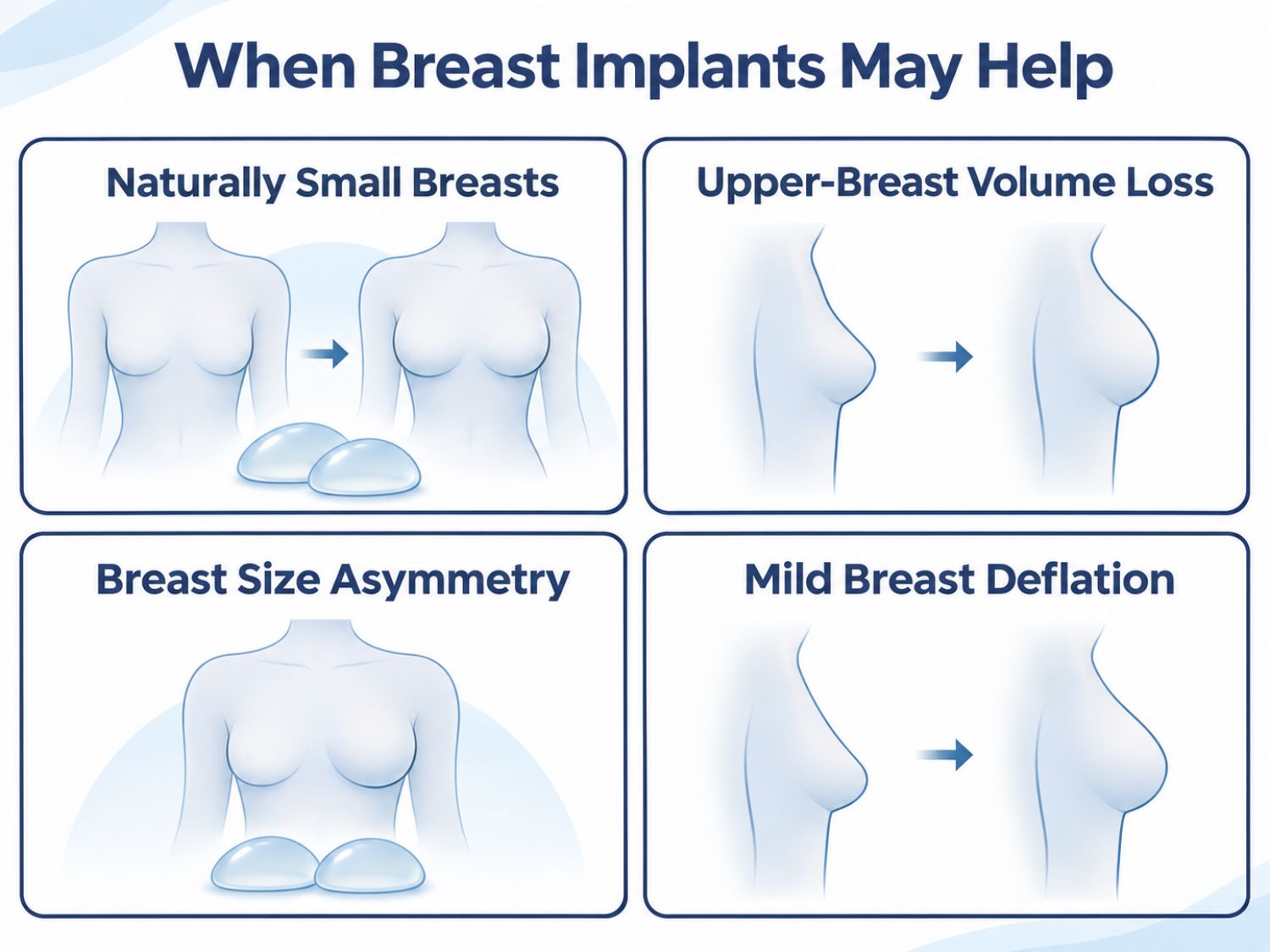
Breast augmentation alone is generally suitable for women who want larger or fuller breasts without significant sagging. It is particularly helpful when breast volume has decreased but the nipples remain in a reasonably natural position.
Common indications include:
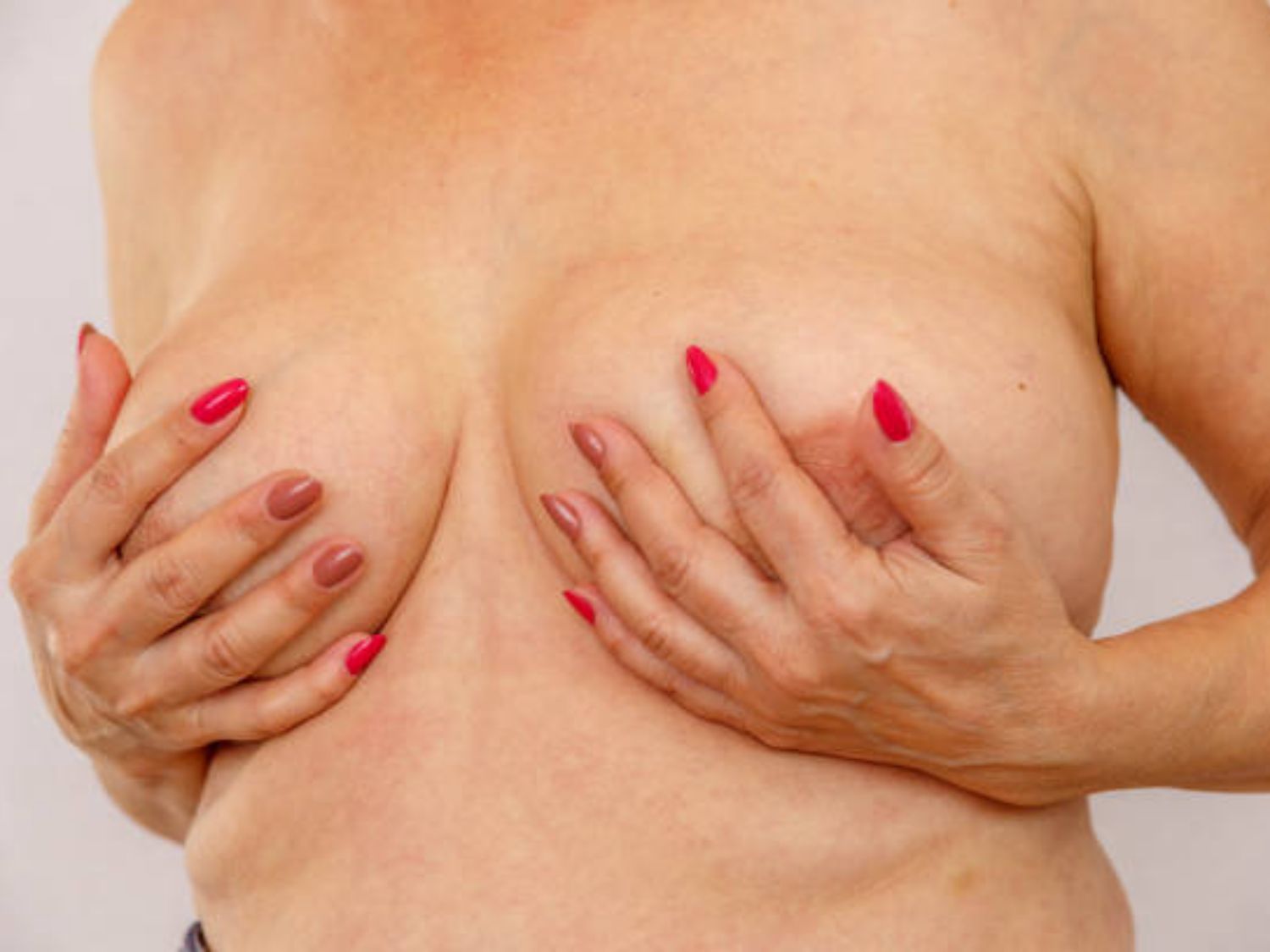
A breast lift without implants is recommended when the breasts have enough natural volume but have become saggy, elongated, or poorly positioned. The procedure improves breast shape using the patient’s existing tissue rather than adding a foreign device.
A breast lift may be appropriate in the following situations:
Combined breast lift and augmentation is most appropriate when the breasts have both significant sagging and insufficient volume. The lift corrects the position and loose skin, while implants restore fullness.
This combination is commonly considered after pregnancy, major weight loss, or age-related changes.
For example, Olivia describes two separate concerns: her breasts have become smaller after breastfeeding, and the breast tissue appears to hang lower than before.
If a physical examination confirms that her nipples sit below the breast crease and the upper breasts have lost considerable volume, a combined procedure may address both concerns more effectively than either surgery alone.

Combined surgery creates opposing forces on the breast tissues: the implant expands the breast, while the lift removes loose skin and tightens the remaining tissue.
This can increase tension on the incisions and make wound healing more demanding, particularly with large implants or severe sagging.
Potential complications include delayed healing, widened scars, implant displacement, changes in nipple sensation, and the need for revision surgery.
In selected complex cases, the surgeon may recommend performing the lift and augmentation in separate stages rather than during one operation.
A combined procedure should be chosen because both corrections are necessary—not simply because two operations can be performed together.
Pregnancy-related breast changes can involve both volume loss and stretched supporting tissues, making it important to assess the breasts after they have stabilized. Some women experience mainly deflation, while others develop significant sagging.
During pregnancy, hormonal changes enlarge the breast glands and increase breast volume. As these changes reverse, the breasts may become smaller while the skin does not fully return to its previous tightness.
Breast appearance is also influenced by genetics, age, weight fluctuations, and skin elasticity. Breastfeeding alone should not be assumed to be the cause of sagging.
The distinction matters:

Breast lifts and breast augmentation both require a period of healing, but recovery differs according to the surgical technique, implant placement, and whether the procedures are combined. Early recovery usually takes several weeks, while final breast shape and scars continue changing for months.
| Recovery factor | Breast Lift | Breast Augmentation | Combined Procedure |
| Early discomfort | Usually soreness and tightness | May include chest tightness and muscle discomfort | May involve both |
| Light daily activities | Often within 1–2 weeks | Often within 1–2 weeks | May take longer |
| Strenuous exercise | Commonly restricted for 4–6 weeks or longer | Commonly restricted for 4–6 weeks or longer | Requires individualized clearance |
| Scar maturation | Several months to over a year | Several months to over a year | Several months to over a year |
| Breast contour settling | Several months | Several months | Several months or longer |
These are general estimates, not guaranteed recovery times. The treating surgeon determines activity restrictions and follow-up schedules.
Smoking and nicotine exposure can impair healing and increase wound complications. Significant health conditions, medication use, and previous breast surgery can also affect surgical planning.
International medical reference: The American Society of Plastic Surgeons (ASPS) explains that breast augmentation and breast lifting address different anatomical concerns. In its January 7, 2020 guidance, the society’s contributing surgeon identifies nipple position, breast volume, and desired breast size as the main considerations when selecting between the procedures.
Both procedures should be performed by appropriately qualified surgeons in facilities equipped for anesthesia, surgical monitoring, and management of complications.
The surgical recommendation should be based on breast measurements, tissue quality, health status, and the patient’s desired outcome rather than cup size alone. A detailed examination helps determine which changes are achievable and whether an implant is necessary.
A breast consultation generally includes:
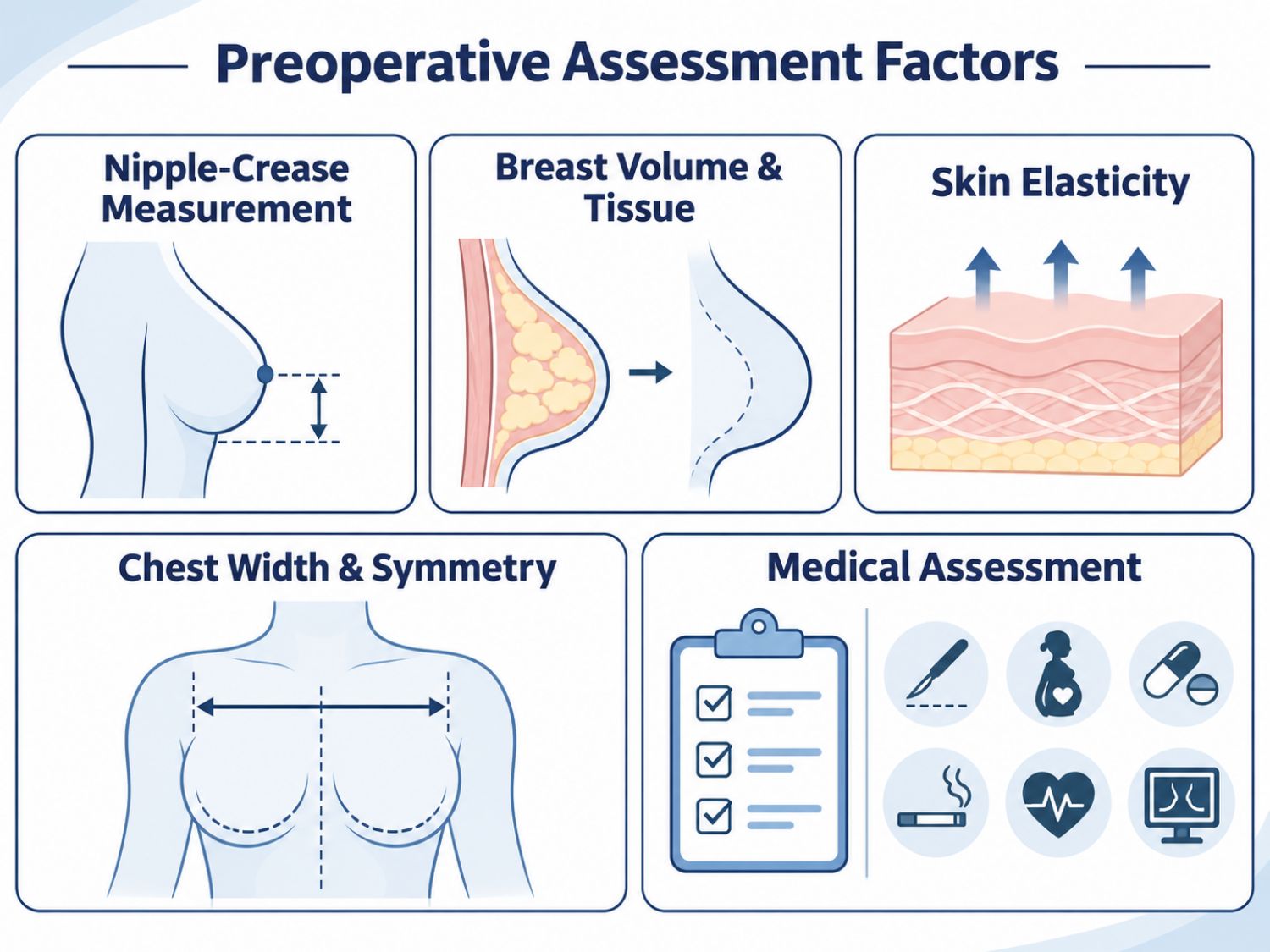
At Kangnam Aesthetic Hospital, published breast surgery information describes assessment of breast sagging, tissue thickness, nipple position, and individual anatomical characteristics before recommending augmentation, a breast lift, or a combined procedure. Kangnam also offers endoscopic implant augmentation and breast reshaping options; patients considering surgery can contact Kangnam for a specialist consultation to discuss which approach best matches their anatomy and desired breast shape.
Fat transfer may provide a modest increase in breast volume using fat collected from another part of the body. However, some transferred fat is naturally reabsorbed, so it cannot reliably provide the same degree of enlargement as implants, and repeat treatment may be necessary.
A breast lift can improve breast asymmetry when the main difference involves nipple position or the shape of existing tissue. When one breast is substantially smaller than the other, additional volume correction or tissue reduction may be necessary to achieve better balance.
Large or heavy implants can place additional strain on breast skin and supporting tissues, particularly when the skin is already stretched. Choosing an implant that matches chest measurements and tissue strength helps reduce excessive tension, although no implant size can prevent future sagging completely.
Many women can breastfeed after breast surgery, but the ability to produce milk may be affected by surgical incisions, tissue rearrangement, and individual anatomy. Patients planning future pregnancies should discuss breastfeeding goals before choosing a procedure.