Date posted: 16-11-2026 | Last updated : 18-11-2026
Breast reduction in Vietnam for foreigners typically requires 1–2 weeks of initial recovery, with strenuous activities restricted for approximately 6–8 weeks. Surgical scars are permanent but generally become less noticeable over several months.
Initial recovery: Most patients can resume light daily activities and desk-based work within 1–2 weeks, depending on healing.
Scar appearance: Incisions usually follow a circular, vertical, or anchor-shaped pattern, depending on the amount of breast tissue and skin removed.
Long-term healing: Swelling gradually improves over 4–6 weeks, while scars can continue fading and softening for 12 months or longer.
International travel: Returning home requires an individualized assessment of wound healing, mobility, complications, and flight duration.
Most patients need approximately 1–2 weeks for initial recovery after breast reduction surgery, while complete tissue healing and breast reshaping take several months. Recovery depends on the amount of tissue removed, incision technique, general health, and postoperative care.

Breast reduction recovery timeline
| Recovery period | What to expect | Recommended activities |
| Days 1–3 | Swelling, tightness, bruising, and soreness are common. Dressings and sometimes drainage tubes are used. | Rest, take prescribed medication, and walk short distances with assistance as needed. |
| Days 4–7 | Discomfort usually begins decreasing, although swelling and tenderness remain. | Gentle walking and basic self-care; avoid lifting and strenuous tasks. |
| Weeks 2–3 | Many patients feel significantly better and can return to nonphysical work. | Light daily activities and follow-up examinations; continue protecting incisions. |
| Weeks 4–6 | Swelling continues improving, and breast contours become more defined. | Gradually increase activity with medical approval and continue wearing recommended breast support. |
| Weeks 6–8 | Deeper tissues become more stable, although healing is ongoing. | Resume exercise and heavier activities only after surgeon clearance. |
| Months 3–12+ | Breast shape becomes more settled, while scars gradually soften and fade. | Attend follow-ups and continue recommended scar care. |
According to the International Society of Aesthetic Plastic Surgery (ISAPS), many patients return to work within 7–10 days, while sports typically resume after 6–8 weeks. ISAPS also explains that swelling commonly persists for 4–6 weeks and that recovery varies according to the individual and surgical technique.
Breast reduction scars are usually located around the areola, vertically toward the breast crease, or along the fold beneath the breast. Their location and length depend mainly on how much tissue and excess skin must be removed.
Common breast reduction incision techniques
| Incision technique | Scar location | Best suited for | Main limitation |
| Periareolar incision | Circular scar around the areola | Selected cases requiring limited skin adjustment | Limited ability to remove significant excess skin; not appropriate for many substantial reductions |
| Vertical or lollipop incision | Around the areola and vertically to the breast crease | Moderate reductions with suitable skin quality | Leaves a visible vertical scar and may not adequately address substantial skin excess |
| Anchor or inverted-T incision | Around the areola, vertically downward, and horizontally beneath the breast | Large reductions or significant breast sagging | Creates longer scars, although the horizontal portion is generally concealed beneath the breast |
Breast reduction scars are permanent, but they usually become flatter, softer, and less noticeable as the skin heals. The degree of improvement depends on skin characteristics, wound healing, incision tension, and individual scar formation.
The appearance of a scar changes through several stages.
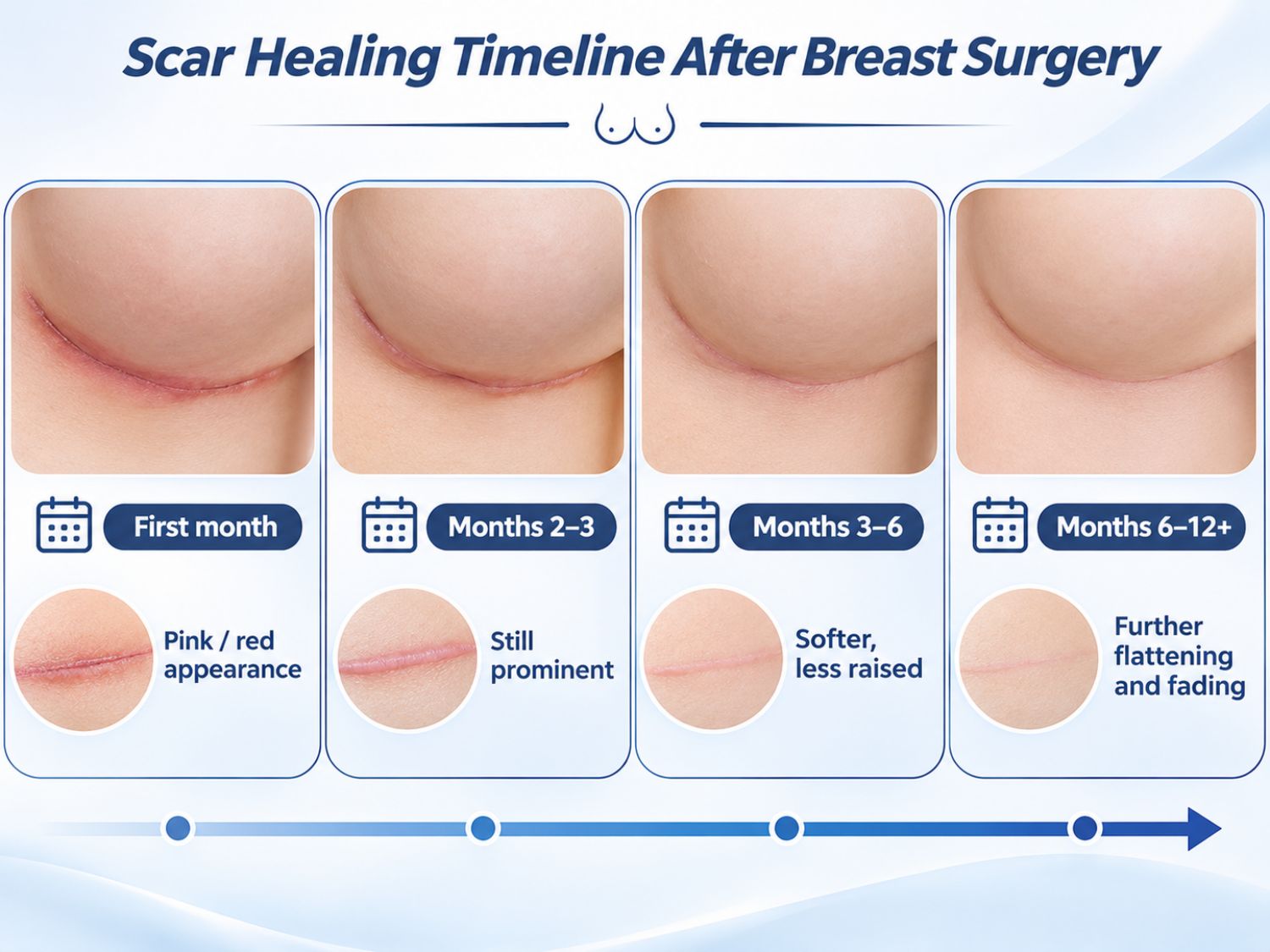
Proper wound care, reduced tension on incisions, sun protection, and suitable scar treatments can help improve the appearance of breast reduction scars. Scar prevention begins with surgical planning and continues throughout the healing process.
The following measures are particularly important.

Patients should avoid applying unapproved scar creams, acids, or home remedies to fresh surgical wounds.
For thickened or persistently raised scars, a plastic surgeon may recommend additional treatments after assessing healing. These may include medical silicone products, targeted injections, or selected scar-revision procedures.
International patients should generally plan for at least 1–2 weeks of local postoperative observation, but some need longer before they are medically fit to fly. The appropriate departure date depends on the extent of surgery, healing progress, planned follow-up appointments, and travel-related risks.
Before approving travel, the treating surgeon should evaluate:
For example, a patient returning to Australia, the United Kingdom, or the United States may face a long journey involving multiple flights and extended sitting.
Such travel requires more careful planning than a short domestic flight.
For Emma, a two-week stay could provide time for an initial recovery and postoperative review. Nevertheless, the return flight should remain flexible until her surgeon confirms that she is fit to travel.
Breast reduction is generally suitable for adults with disproportionately large or heavy breasts who experience physical discomfort or want a smaller breast size. Final eligibility depends on medical evaluation, realistic expectations, and the ability to complete postoperative care.
Women frequently consider breast reduction because of:

Certain conditions can increase surgical or healing risks.
These include uncontrolled diabetes, significant obesity, smoking, clotting disorders, previous breast surgery, and relevant heart or lung conditions.
Patients planning pregnancy or breastfeeding should also discuss the timing of surgery, because breast reduction can affect nipple sensation and the ability to breastfeed.
A surgeon may request blood tests, breast imaging when indicated, and a review of medications before confirming the operation.
Mild swelling, bruising, and discomfort are expected after breast reduction, but worsening pain, unusual swelling, fever, or wound changes require prompt medical assessment. Recognizing complications early is particularly important for international patients who may soon be traveling home.
Potential complications include:
Sudden chest pain, breathing difficulty, or fainting requires immediate emergency medical care. Patients should not wait for an online consultation or attempt to manage these symptoms through messaging.
An appropriate postoperative plan must provide a clear route to urgent assessment, both while staying in Vietnam and after returning home.
Kangnam Aesthetic Hospital lists breast reduction as part of its breast-reshaping services, alongside breast lifting and areola reduction. International patients can arrange a pre-travel online consultation to discuss surgical goals, estimated costs, recovery planning, and follow-up arrangements. Contact Kangnam to request an individualized breast reduction assessment and a suitable treatment plan before traveling to Vietnam.
Traveling alone is possible, but assistance is strongly recommended during the first few postoperative days. Arrange someone to help with transportation, meals, luggage, and daily activities until you can manage comfortably.
Breast reduction may reduce the ability to breastfeed because the operation can affect milk-producing tissue, ducts, or nerves. The risk depends on the surgical technique and how much tissue is removed, so future breastfeeding plans should be discussed before surgery.
Yes, breast reduction or reshaping may be performed in selected patients with existing implants, sometimes together with implant removal or replacement. The surgeon must assess implant condition, breast tissue, skin quality, and previous incision patterns before planning the operation.