Date posted: 13-11-2026 | Last updated : 18-11-2026
A brow lift and a temporal lift can both improve upper eyelid hooding caused by brow ptosis, but they differ in the areas they address. A brow lift adjusts the entire or a large portion of the eyebrow and is suitable when the inner, middle, and outer sections of the brow have all descended. A temporal lift, on the other hand, focuses on elevating the outer third of the eyebrow and tightening loose skin in the temple area.
A brow lift addresses a broader area and can adjust the position of the inner, middle, and outer sections of the eyebrow.
A temporal lift primarily improves a drooping tail of the eyebrow and loose skin around the temples.
A brow lift is suitable when the entire brow has descended, while a temporal lift is more appropriate when only the tail of the brow is low and the inner and middle sections remain in a good position.
Both procedures can reduce upper eyelid hooding caused by a descended brow.
If drooping is caused by excess upper eyelid skin or weakened levator muscles, upper eyelid surgery or ptosis correction may need to be considered.
The choice of technique should be based on an in-person examination, not solely on the desired eyebrow shape.
A brow lift addresses the entire or a large portion of the eyebrow to correct more widespread brow descent, whereas a temporal lift primarily elevates the outer third of the eyebrow and the soft tissue around the temples. This is the most important distinction when choosing between the two procedures.
A brow lift is suitable when brow descent affects the entire or a large portion of the eyebrow, including its inner, middle, and outer sections. This procedure provides support across a broader area of the brow and improves upper eyelid hooding caused by a low brow position.
The following conditions may lead a surgeon to consider this procedure:

A temporal lift is suitable when the inner and middle sections of the eyebrow remain in relatively good positions, but the outer third of the brow has drooped. The surgery focuses on lifting the temple area and the soft tissue along the outer brow to improve hooding at the outer corner of the eye.
Common signs include:
According to the American Academy of Facial Plastic and Reconstructive Surgery (AAFPRS), a temporal brow lift is commonly used for mild to moderate brow ptosis concentrated in the outer portion of the eyebrow. It does not directly address the central part of the brow. Therefore, if the entire eyebrow has descended, a temporal lift alone may not fully meet the client’s rejuvenation goals.
Source: https://www.aafprs.org/Consumers/Procedures/FacialRejuvenation/Forehead/A/FR1.aspx
Drooping-looking eyelids can have three main causes: a low brow position, excess upper eyelid skin, or weakened levator muscles. Brow lifts and temporal lifts primarily address the first cause. They do not replace upper eyelid surgery or levator muscle repair when either procedure is indicated.
Drooping eyelids caused by brow ptosis
When the eyebrows descend, the skin above the upper eyelids is pulled downward, making the eyelids look heavy, smaller, and partially covered. This can affect the entire brow or be concentrated around the tail.
Upper eyelid hooding caused by excess skin
Excess skin is concentrated directly around the upper eyelid, forming a fold that covers the eyelid crease or partially obstructs the eye area. In this case, upper blepharoplasty may be considered to remove an appropriate amount of excess skin.
If the client also has brow ptosis, the surgeon may assess whether a brow lift should be combined with upper eyelid surgery. The amount of skin to be removed must be determined with the post-lift brow position in mind to avoid removing too much upper eyelid skin.
True ptosis caused by the levator muscle
This condition occurs when the upper eyelid margin sits lower than its normal position. It may partially cover the pupil and affect vision. The cause is often associated with abnormalities of the levator muscle, its aponeurosis, or the nerves that control it.
Unlike skin laxity that covers the eye, true ptosis requires an assessment of levator muscle function. The surgeon may recommend surgery to correct the levator muscle.
In Vietnam, brow lifts and temporal lifts can be performed using various techniques, which are classified according to incision location and the extent of tissue elevation. Commonly discussed approaches include direct brow lifts, endoscopic brow lifts, and temporal lifts.
Direct Brow Lift
The surgeon makes an incision close to the upper or lower edge of the eyebrow, depending on the surgical plan. The tissue is then adjusted, and the necessary amount of excess skin is removed to reposition the brow appropriately.
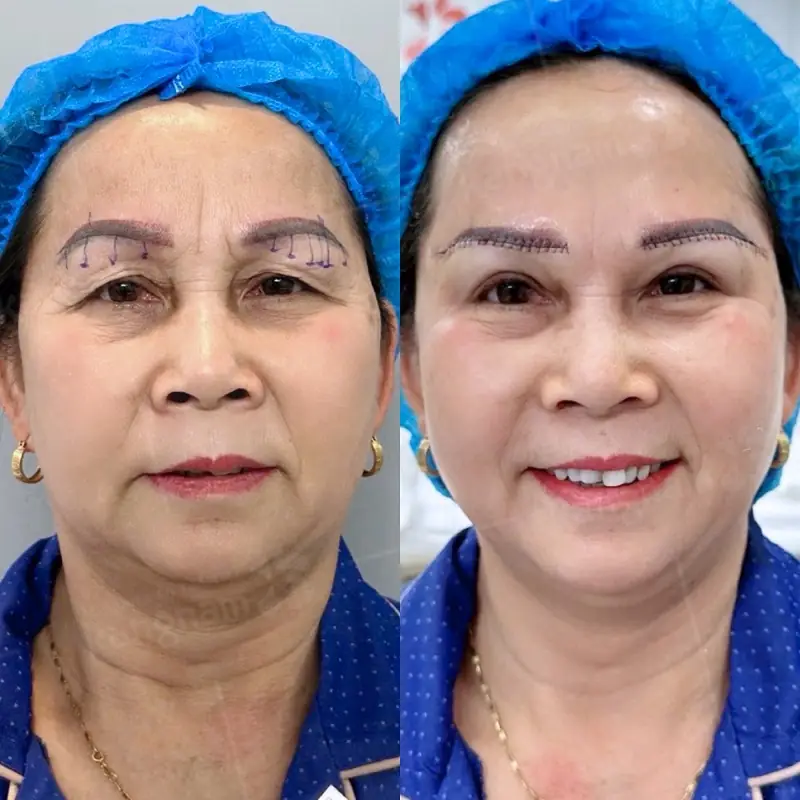
Endoscopic Brow Lift
The surgeon makes several small incisions within the frontal hairline and inserts an endoscope to visualize, release, and elevate the soft tissue.
Temporal Lift
The surgeon makes an incision within the temporal hairline, then releases and elevates the soft tissue in the temple area, focusing on the tail of the eyebrow.
Both brow lifts and temporal lifts can leave surgical scars. Their location and visibility depend on the surgical technique, incision placement, individual healing characteristics, and postoperative care.
Scar locations:
Recovery time:
After surgery, clients may experience swelling and bruising around the forehead, temples, or eyes. Some may also feel tightness, mild numbness, or itching around the treated area.

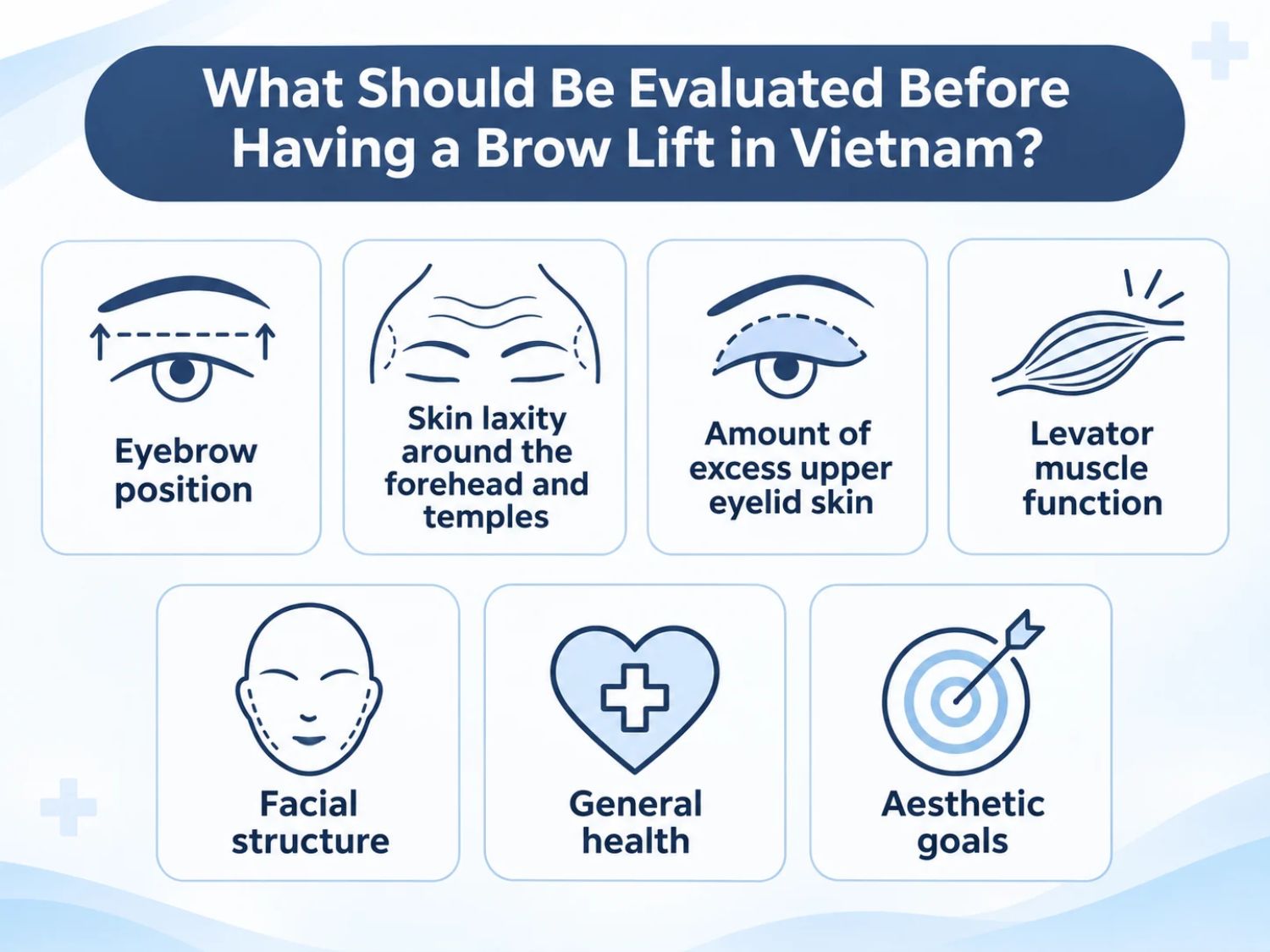
Before performing a brow lift or temporal lift, the surgeon needs to assess eyebrow position, the degree of excess upper eyelid skin, skin laxity around the forehead and temples, and levator muscle function. This examination helps identify the actual cause of the drooping appearance and determine the appropriate surgical area.
The assessment should include:
A brow lift can improve eyelid hooding caused by brow ptosis, making the eye area look more open and the eyelid crease more defined. However, it does not treat true ptosis caused by weakened levator muscles. In such cases, surgery to correct the levator muscle needs to be evaluated.
Yes. A temporal lift primarily affects the outer third of the eyebrow, so it can change the height and curvature of the brow tail. The extent of the change depends on the technique, the initial degree of brow ptosis, and the aesthetic goals.
The procedures may be combined if the client has both brow ptosis and excess upper eyelid skin. However, the surgeon needs to determine how much excess skin remains after the brow has been lifted. This helps prevent excessive skin removal, which could make it difficult to close the eyes or affect the eyelids’ protective function.
Mini Facelift vs. Full Facelift: Which Procedure Should You Choose Based on Your Age?