Date posted: 21-07-2026 | Last updated : 25-07-2026
Fat accumulation beneath the chin can make the face appear less defined and is commonly referred to as a double chin. Double-chin liposuction is a treatment designed to remove this localised fat and create a slimmer lower face.
However, how long does it take for the chin to look natural and fully healed after liposuction?
Noticeable improvement may become visible approximately two to three weeks after double-chin liposuction.
During this period, swelling gradually decreases and the chin contour becomes more defined. After approximately one month, the treated area may begin to look softer, more natural, and better balanced with the rest of the face.
The final result generally continues to improve over the following one to three months.
The main recovery stages include:
The chin may be mildly swollen, bruised, tender, or tight after liposuction. These are common reactions to the procedure.
Kangnam applies modern fat-removal techniques designed to limit unnecessary tissue trauma. However, the degree of swelling and bruising still varies between patients.
Swelling and bruising commonly decrease significantly during this period.
The skin begins adapting to the new contour, and the jawline may appear more clearly defined.
The chin may appear noticeably slimmer, while the skin and soft tissues continue to settle.
However, the area should not be considered fully healed after only two to three weeks. Residual swelling, firmness, or numbness may still be present.
The result commonly becomes more stable after approximately one to three months.
The contour may remain long-lasting when the patient:
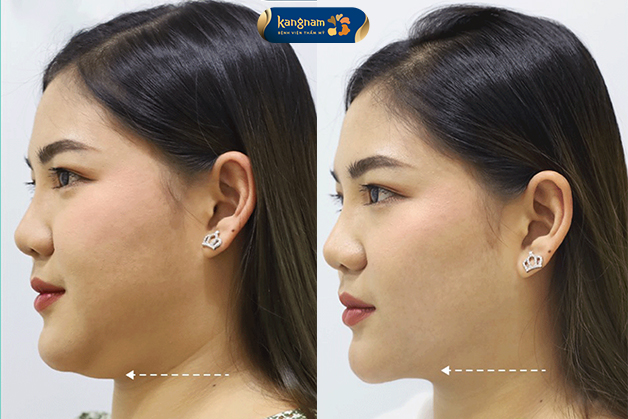
Double-chin fat reduction may create a noticeably slimmer lower face after the swelling subsides.
Claims that all fat is completely removed, that the skin will never sag, or that there will be no contour irregularities cannot be guaranteed.
Patients can learn more about the procedure in Chin Liposuction: Technology, Procedure, Cost, and Results.
Double-chin liposuction generally requires a relatively short recovery period compared with larger body liposuction procedures.
Many patients may need approximately one to two days of rest before resuming light daily activities.
However, patients should continue to avoid:
These restrictions are commonly recommended during the first week or according to the surgeon’s instructions.
Kangnam applies Lipo 360 technology to selected chin-liposuction procedures. Ultrasound-assisted or energy-assisted techniques may help loosen the fat before removal and support more controlled extraction.
These methods may reduce unnecessary tissue trauma, but they cannot guarantee:
The medical team may prescribe pain relief, anti-inflammatory medication, or other postoperative medication when clinically appropriate.
Patients should not take antibiotics, anti-inflammatory drugs, or supplements without following the doctor’s instructions.
They may also be advised to wear a chin compression garment to support the treated area and help control swelling.
Further information about the general recovery process is available in Facial Liposuction: Procedure, Benefits, and Recovery.
Double-chin liposuction requires one or more small access incisions, commonly placed beneath the chin or within a natural skin fold.
The incisions are often only a few millimetres long, allowing the surgeon to insert a small liposuction cannula.
Because the incision is small and located in a discreet area, the resulting scar may become difficult to notice over time.
However, it is not medically accurate to guarantee that the procedure will leave no scar.
The final appearance of the scar depends on:
Fine surgical sutures may be used to close the incision and reduce unnecessary tissue trauma.
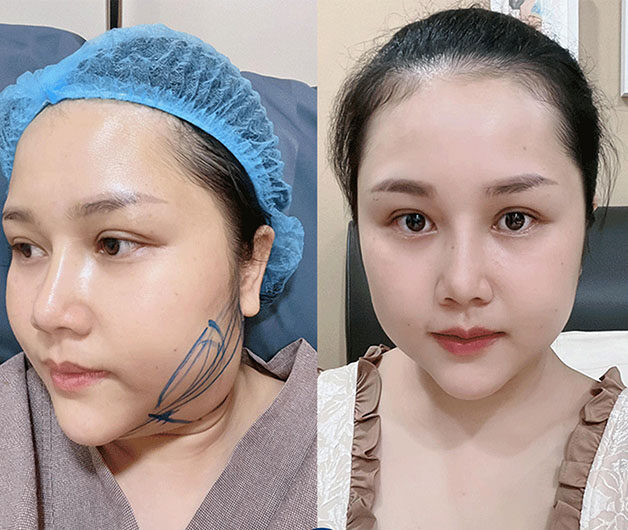
Double-chin liposuction uses small and discreetly positioned incisions.
Kangnam may also provide scar-care guidance or treatments after surgery. These may support scar improvement but cannot guarantee that the scar will disappear completely.
Patients should seek medical advice if the incision becomes:
To support recovery and achieve the best possible aesthetic result, patients should follow the surgeon’s instructions carefully.
Patients should take prescribed medication at the correct dose and time.
They should not independently add, stop, or change medication without consulting the treating doctor.
Keep the incision clean and dry according to the medical team’s instructions.
Avoid pressing, scratching, or rubbing the chin.
A cold compress may help reduce swelling during the first 24–48 hours.
It should:
Patients should follow the surgeon’s instructions because cold therapy may not be suitable in every case.
A balanced diet containing protein, fruit, vegetables, and suitable sources of vitamins may support wound healing.
Patients may be advised to limit:
There is no single food that can guarantee faster healing or prevent every complication.
Patients should avoid intense exercise, heavy lifting, and forceful neck movement for at least the first week or as advised by the surgeon.
Gentle walking may be encouraged to support circulation.
Massage should only be performed when the surgeon confirms that it is appropriate.
Incorrect or premature massage may:
If massage is recommended, patients should follow the specific technique and timing provided by the medical team.
Follow-up appointments allow the doctor to monitor:
Patients should seek prompt medical attention if they develop:
Double-chin liposuction at Kangnam may help remove localised fat and create a slimmer, more defined lower face.
However, the result does not become fully established immediately. Most patients notice clear improvement after two to three weeks, while the final contour commonly takes one to three months to settle.
Proper postoperative care, realistic expectations, and regular follow-up are important for maintaining the result and reducing avoidable risks.
Chin Liposuction: Technology, Procedure, Cost, and Results
How Much Does Double-Chin Liposuction Cost?
Facial Liposuction: Procedure, Benefits, and Recovery
What Is Liposuction? Procedure, Cost, and Safety Considerations